
Family Values: Locating the Family in the Early Modern Italian Workshop
The first strand of activities, proposed by Dr Louise Bourdua and Dr Victoria Avery of Warwick’s History of Art department, concentrated on the family (an elementary form of community organisation) and its impact on the early modern Italian workshop in both a broader Italian and English context.
This programme took the form of a seminar series held at Warwick and at its base in Venice during the academic year 2009-2010. Warwick’s facility at the Palazzo Pesaro-Papafava in Venice provides the base for the ‘Venice term’ offered to third year History and History of Art undergraduate students, Masters students enrolled on the MA "Venice and its Legacy", and PhD students who research on Venice and the Veneto. The Palazzo, which has dedicated administrative support and its own library, also serves as a research base for faculty whose research interests lie in the areas of Italian Renaissance history and art. The facility, which has excellent conference and seminar space, is integral to and enhances Renaissance Studies at Warwick. [PPP Map ]
]
The activities included:
a. a two-day workshop (including a fieldtrip) at Warwick on Friday and Saturday 30-31 October 2009. This funded approx 12 participants from the United Kingdom and 2 guest lecturers from the UK and Italy. Poster. Final Report
b. a second workshop held at Warwick-in-Venice on Tuesday and Wednesday 6-7 April 2010 – immediately before the annual Renaissance Society of America Conference in Venice). This funded around 15 participants from the United Kingdom and 3 guest lecturers from North America. Further details
c. a two-week residential workshop (held at Warwick-in-Venice 18-31st July 2010). This fund approx 24 participants from North America and the United Kingdom with further guest lecturers from Italy. Further details
d. Each year’s activities will be followed by two eight-week Visiting Fellowships; these will offer the opportunity to two of the selected Workshop Participants to build on the contacts and research collaborations established in the course of the previous year. Applications for these Fellowships will be open and not dependent on having attended one or other of the previous workshops, however priority will be given to applicants from Newberry Center for Renaissance Studies consortium universities. For a list of eligible institutions click here
Rationale:
Cultural production in early modern Italy was intimately tied to neighbourhood, friendship and extended kinship ties. The family in particular was a key component of identity but as the historian Thomas Kuehn observed some years ago, the family was not just a ‘genetically constituted, co-residential unit of production and consumption. It was a group with practical interests that were mediated by cultural logic’. Whilst studies of patronage have shed much light on the dynastic relationships of artistic patrons and agents, particularly through the work of Haskell, Bourdua and others, much work remains to be done on the makers’ families. In his groundbreaking study of 1938, Martin Wackernagel briefly drew attention to this phenomenon, but there is as yet no systematic or extended study.
Recent archival discoveries suggest that artistic dynasties dominated production of both large- and smaller-scale works of art ranging from painting and sculpture, to decorative objects such as bronze statuettes and glassware and functional objects such as steeple bells and artillery. This proposal will consider and debate the following issues:
(1) the role of fathers and sons in artistic production, including both biological and adopted children, for the latter became a practical solution for childless masters or those with sons lacking talent and/or volition, as in the well known case of the painters Squarcione and Mantegna;
(2) the importance of marriage and the role of women in artistic families in particular the position of daughters in the workshop as potential artistic successor (such as Lavinia Fontana or the Castelli sisters, bell founders), or as spouse for the talented apprentice;
(3) the role and extent of the ‘extended’ family, such as uncles, cousins, sons/brothers-in-law and when should we consider such workshops ‘independent’ (the case of Giovanni Bellini and Andrea Mantegna comes to mind);
(4) the impact of death, family conflict or break-up in artistic production;
(5) the impact of family workshops on artistic style and form over the longue durée from the fourteenth to the eighteenth century.
Warwick’s presence in the English Midlands and the
The second workshop (b) and summer school (c) were located in the Palazzo Pesaro Papafava, Warwick-in-Venice’s base in this city. Seminar papers by visiting speakers and Warwick/Consortium faculty were invited on the topic of family relationships within the Italian artistic workshop and the pre-eminence this had over other arrangements. A key part of the Venice-based activities took the form of workshops and daily guided visits for doctoral students and post-doctoral fellows to key sites including extant artistic workshops and artisans/architects’ homes. Time was also spent exploring the city’s wealth of pertinent archival material. The former site visits enabled examination of the spatial environment of some of the key artistic families in Venice, while the latter equipped participants with valuable investigative tools for current and future research. For a fuller report of the year's activities, including participant list click here
Workshops were led by world-renowned scholars, including many from the Newberry Consortium of 49 Universities from North America and the UK. ttp://www.newberry.org/renaissance/consortiuminformation.html
¹ http://www2.warwick.ac.uk/fac/arts/arthistory/research/staffinterests/avery/
² http://www2.warwick.ac.uk/fac/arts/arthistory/research/staffinterests/bourdua/
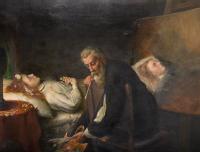
Tintoretto Painting his Dead Daughter by H. N. O'Neil. Published by kind permission of the Wolverhampton Art Gallery and Museum
Fellowship report-Emily Price
Fellowship report - Megan Moran
Photos from Venice Summer School, July 2010