
Video Denoising

Our recent work has looked at the problem of restoring digital video data corrupted with noise (white Gaussian). We employ a transform-domain thresholding framework using both separable and non-separable wavelet-type representations. The basic idea behind this approach is that the most prominent spatiotemporal structures present in a sequence can be captured using a representation with well-localised basis functions.
Planelets were developed at Warwick to efficiently represent locally planar spatiotemporal structures present in a video sequence. They are planar wave functions localised in time, space, frequency, and orientation. They are shown to yield plausible gains in terms of both SNR and visual quality when restoring noisy video sequences. The computation of discrete planelet transform is quite inexpensive and can be carried out in O(n) time, where n is the size of the analysis window (16x16x16, in the example below). Three-dimensional (3D) wavelet packets, on the other hand, are optimal in terms of representing local spatiotemporal frequencies. They, however, lack orientation selectivity and are relatively speaking computationally expensive.
MATLAB Code
Experimental Results
 |
 |
 |
 |
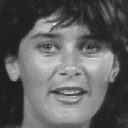
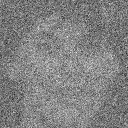
| Original | Noisy | Denoised with | Denoised with |
| frame | frame | Planelets | 3D Wavelet Packets |
| (0 dB) | (18.1 dB) | (18.9 dB) |
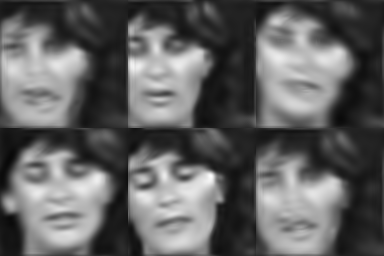
Restoration results for frame# 63 of 128x128x128 Miss America sequence
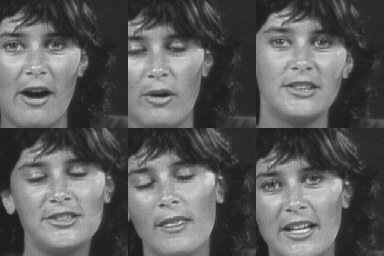
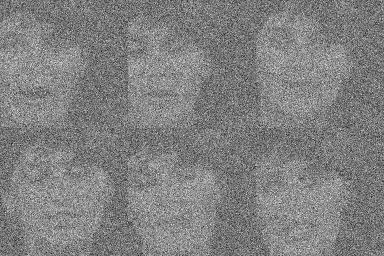
Click here to see the original, noisy, and denoised sequences side by side.
(Warning! High bandwidth may be required.)
Test/Results Data
If you would like to download the sequences for all of the above, click on the following links.
Original Miss America sequence
Noisy (0dB white Gaussian noise)
Planelets denoising results (18.1 dB)
Wavelet packets denoising results (18.9 dB)

Relevant Publications
-
NM Rajpoot, Z Yao, RG Wilson,
Adaptive Wavelet Restoration of Noisy Video Sequences,
in Proceedings International Conference on Image Processing (ICIP'04), Singapore, October 2004


-
NM Rajpoot, RG Wilson, Z Yao,
Planelets: A New Analysis Tool for Planar Feature Extraction,
in Proceedings 5th International Workshop on Image Analysis for Multimedia Interactive Services (WIAMIS'04), Lisbon (Portugal), April 2004
-
RG Wilson, NM Rajpoot,
Image Volume Denoising Using A Fourier-Wavelet Basis,
in Proceedings Baiona Workshop on Signal Processing in Communications (Baiona SPC'2003), Baiona (Spain), September 2003