
Careers
- The underpinning skills and knowledge developed on a mathematics degree are highly valued by employers across a variety of sectors. Surveys of graduate career destinations consistently show that approximately 30% of mathematics graduates progress to a career in financial and professional services What do graduates do, the destinations of Warwick mathematicians are broadly similar.
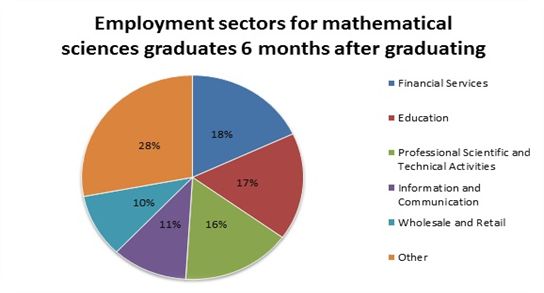
Source: The Institute of Mathematics and its Applications 2013 (Graduates entering further study were not included in this research)
- It is worth noting that approx. 80% of the top graduate recruiters do not specify a degree discipline - analytical and problem-solving skills are developed to a very high level on a mathematics degree and these skills are very transferable, so you can also realistically also consider a career in non-finance related sectors. A number of Warwick mathematics graduates have successfully developed careers in meteorology, the games industry, software, the arts and the media and data analytics, for example.
- The value of a mathematics degree was highlighted by the Council for Mathematical Sciences (CMS) in their 2015 report which found that the demand for job applicants with numerical qualifications has significantly increased and that almost 2,000,000 people now work in jobs where mathematical sciences qualifications are essential. The research also concluded that this demand is reflected in salary levels, ‘In 2012/2013, just six months after graduation, the median salary for mathematical sciences graduates was £24,000. 19% of those graduates were already earning more than £30,000 and 7% were already earning £40,000 or more.’ (The Mathematical Sciences People Pipeline, Oct 28th 2015)
What do employers require?
- The Warwick Mathematics degree is a highly credible qualification and has an excellent reputation. Employers do not only require high levels of academic achievement however, they also look for a variety of ‘employability skills’ Employability Skills According to the ‘High Fliers’ annual survey of recruitment in the graduate labour market, nearly 60% of top employers state that graduates have ‘little or no chance of finding a graduate level job without work experience’ Value of work experience
- The most convincing way to demonstrate these additional skills is to gain experience – any experience is valuable if you present it in a way relevant to the job role and the employer’s requirements. During and throughout your degree, consider the opportunities available to you on campus (through volunteering, extra-curricular and society involvement, for example) and through work experience, placements and internships. You can search for opportunities to gain experience on the Careers and Skills portal My Advantage https://myadvantage.warwick.ac.uk/ and the ‘Experience Pool’ Get experience
What impact will module choices have on my career plans/options?
- If you are worried about how choosing your degree options might affect the choices open to you after graduation this may not have as much impact as you think.
- Generally speaking there are many factors that employers consider before they start looking at the way your degree was structured. They are interested in your motivations and interests and why you've chosen a particular career. Option choices can help here, the Challenges of Climate Change module, for example, would indicate commitment and enthusiasm to an employer in the renewables sector.
- For some careers, your general level of academic attainment is important and if you want to enter one of these, it would be a shame to jeopardise a 2.i by choosing an unknown area of study that you might find overly stretching.
- The key message is: if you know what career area you want to enter, option choices are one way to prepare for this and you might want to discuss them with your tutor or a careers consultant. However, if, like many, you have a very open mind as to your future area of work, choose options that you will enjoy and that will hold your interest as these are the ones where you are most likely to find the motivation to work hard and do well.
What advice and information is available through the universities Careers & Skills Service?
- The departmental careers consultant is Ray Ryan and individual appointments can be booked with him through My Advantage Book an appointment or by emailing him directly at r.ryan@warwick.ac.uk The advice offered is impartial, is designed to help you feel more confident about making a career decision and takes place in a confidential setting, either in the Zeeman building or the Learning Grid at University House. The agenda of the careers appointments is set by the student and may include for example:
- Discussing career options with a mathematics degree
- Application advice (CVs, on-line applications & cover letters)
- Preparation for an interview and/or assessment centre
- Academic support is also available through the Skills team, you may want to develop your study skills, your time management skills to prepare for assignment deadlines or to prepare more effectively for examinations and dissertation writing, for example Skills.
- If you're hoping to find employment in the UK after graduation and English isn't your first language, think about ways in which you can improve your conversational language skills so that you can approach job interviews, for example, more confidently. The Centre for Applied Linguistics runs classes for our non-native speaking students, Learning English
Don't leave it too late!
Don't leave your career planning until your final year though. You are welcome to visit the Careers Service at any time during your academic career. We are happy to see you if you have no idea or lots of ideas about what you want to do next. For those of you looking for career inspiration the Careers Hub and Weblink online resources hold information on a wide range of jobs and you can try your hand at the computer based `Prospect Planner' to generate career ideas - see www.prospects.ac.uk. We may also run specialist appointments for maths students – see our Website for information about how to make an appointment.
|
Second year students in particular: to continue onto the third year of the MMath you need to reach a certain standard at the end of the year. Many of you who are currently on the MMath will not be by the end of year 2 so if you did not get a first in year one there is a strong possibility you could be in your penultimate year now! |
Undertaking Volunteer projects can also develop essential transferable skills such as communication, teamwork and project management. Please visit www.warwick.ac.uk/volunteers to access the Warwick Volunteers site. Possible projects include student mentoring, student tutoring, Kidz Kamp and many more.
During the forthcoming academic year, there will be a range of events and sessions relevant to maths students and the careers consultant who works with maths will be available in the department at times throughout the year for appointments (although you can also make appointments throughout the year at University House).
How to Impress
Look at any recruitment advertisement for graduates and you'll see what they want. Yes, of course they want the applicants to have a good degree, but they want to see good transferable skills as well. Transferable skills? Things like really good communication skills, team-working, negotiation and persuasion, resilience, initiative, planning and organising and problem solving skills. That's just an example of the sort of generic skills, that can be adapted to many different types of workplace, that employers are demanding today.
Transferable Skills from the Mathematics degrees
You can develop your skills in a number of different ways. Firstly, through your studies - mathematicians have good analytical skills, will think logically and be good at solving problems. Secondly, think about how work experience can develop things like team-working, dealing with people, multi-tasking, drive, initiative and taking responsibility. Getting involved in other extra-curricular activities like clubs and societies will also give the opportunity to develop and demonstrate those skills that the employers want to see.