
News archive
For more recent stories, see our front page and twitter feed @warwickastro
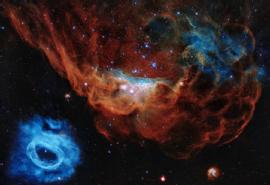 24th April 2020: Hubble turns thirty. On April 24th, 1990, the Hubble Space Telescope was launched onboard the space shuttle Discovery, and was deployed a day later into an orbit that takes it around the Earth once every 96 minutes. Located above the Earth's blurred atmosphere, Hubble has been taking countless stunningly beautiful pictures of planets, stars and galaxies that have kept us breathlessly admiring the beauty of space for the past three decades. Warwick is among Europe's most active Hubble users, and is celebrating this birthday.
 23rd April 2020: Dr Joseph Lyman of the Astronomy and Astrophysics group is one of four Warwick academics to receive a highly-prestigious UKRI Future Leaders Fellowship in the third round of awards. Joe's project, titled "New frontiers in transient astrophysics: gravitational-wave multi-messenger events and exotic stellar explosions", is devoted to furthering our understanding of the changing night sky. See the Warwick press release here.
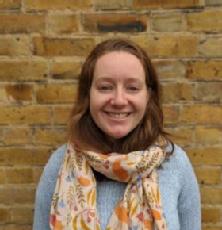 6th March 2020: A Warwick astronomer is amongst the first of the new UKRI Stephen Hawking Fellows announced today. We're delighted to be welcoming Dr Rebecca Nealon who is moving here from the University of Leicester to pursue her research on protoplanetary disks and how they impact the evolution of planets in solar systems outside our own. Rebecca’s simulations have a huge role to play in expanding our understanding of what might be possible elsewhere. Rebecca is also a great communicator who will exploit the focus on public engagement within the Stephen Hawking Fellowship, which we especially welcome, to promote science. The Stephen Hawking Fellowships were launched by UK Research and Innovation (UKRI), working with the Hawking family, in recognition of Stephen Hawking’s exceptional contributions to scientific knowledge and popularisation of science. See the Warwick press release here.
2nd March 2020: A massive white dwarf star with a bizarre, never seen before
hydrogen/carbon atmosphere could be two stellar remnants that merged
together. Less than 50 pc away, this is the first time that a merged white dwarf
has been identified using its atmospheric composition as a clue. This star is
useful in demonstrating how massive white dwarf mergers can get and still
survive without self-annihilation in supernovae Ia. This study led by Dr Mark Hollands has been published in Nature Astronomy, read the Warwick press release here.
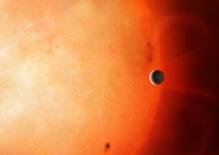 20th February 2020: Researchers from our NGTS team have identified an exoplanet on the edge of destruction. The new study, led by our James McCormack, has observed an exoplanet orbiting a star in just over 18 hours, the shortest orbital period ever observed for a planet of its type. It means that a single year for this hot Jupiter – a gas giant similar in size and composition to Jupiter in our own solar system – passes in less than a day of Earth time. See the Warwick press release here.

1st February 2020: The Astronomy and Astrophysics group is delighted to welcome Dr Heather Cegla as a new UKRI Future Leaders Fellow. Heather's work will develop and enhance our understanding of planets in solar systems outside our own with a focus on the habitability of exoplanets and its implications for the evolution of life.
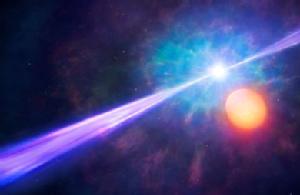
13th January 2020: New work from our Ashley Chrimes and Elizabeth Stanway has used cutting-edge models of stellar evolution to explore the potential progenitors of gamma ray bursts - the brightest explosions amongst the supernovae that end the lives of stars. They found that tidal influence from a binary companion can spin up the star which explodes, making gamma ray bursts more likely. The work is published in Monthly Notices of the Royal Astronomical Society and you can read the Warwick press release here.
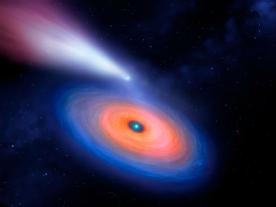
5th December 2019: The first giant planet orbiting a white dwarf has been discovered by Dr Boris Gänsicke and his colleagues. Using the Very Large Telescope of the European Southern Observatory, the authors of this study detected a large gaseous disc around the white dwarf, composed of hydrogen, oxygen and sulphur. This disc is formed from the atmosphere of a giant planet, probably similar to Uranus or Neptune that is evaporated by the intense extreme-ultraviolet radiation from the hot (28000K) white dwarf. This study has been published in Nature, read the Warwick press release here.
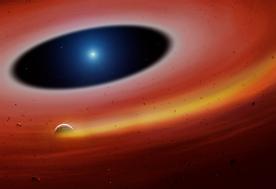
5th April 2019: An international team lead by Dr Christopher Manser has discovered a planetesimal on a 2 hour period orbiting a white dwarf using a new spectroscopic method. Published in the journal Science, the team has determined that the small body has either a high density and/or a large internal strength, like an iron-dominated planetary core fragment. The method developed in this project can be readily applied to a number of other white dwarf planetary systems, and will hopefully unveil the presence of planetesimals at these systems. The Warwick press release is here.
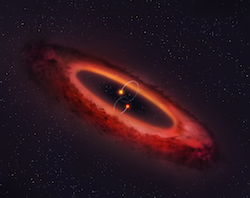
14 January 2019: Four stars, one circumbinary disk, four different orbital planes. A team led by Royal Society URF Dr Grant Kennedy has discovered an unusual orbital configuration for the circumbinary disk in the HD 98800 quadruple system. In this system the disk orbits one binary pair, but at right angles to the binary orbital plane. While such "polar circumbinary" disks have been posited to exist, this discovery marks the first observational evidence, and provides a hint that planets may be able to form on such orbits. The result is published in Nature Astronomy and the Warwick press release is here.
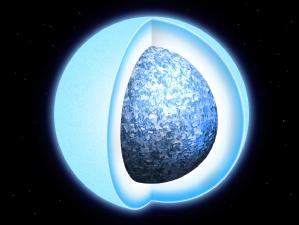 9 January 2019: Data captured by ESA’s galaxy-mapping spacecraft Gaia have revealed for the first time how white dwarfs, the dead remnants of stars like our Sun, turn into solid carbon/oxygen spheres as the hot gas inside them cools down. This process of solidification, or crystallisation, of the material inside white dwarfs was predicted 50 years ago but it wasn’t until the arrival of Gaia that a Warwick team lead by Dr Pier-Emmanuel Tremblay were able to observe enough of these objects with such a precision to see the pattern revealing this process. The result is published in Nature.
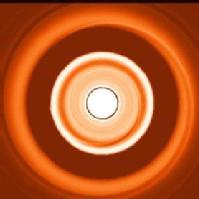
21st October 2018: New research by a team led by Dr Farzana Meru at the University of Warwick has a way of finally telling whether newly forming planets are migrating within the disc of dust and gas that typically surrounds stars or whether they are simply staying put in the same orbit around the star. Finding real evidence that a planet is migrating (usually inwards) within such discs would help solve a number of problems that have emerged as astronomers are able to see more and more detail within protoplanetary discs. In particular it might provide a simple explanation for a range of strange patterns and disturbances that astronomers are beginning to identify within these discs.
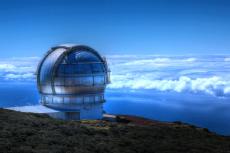 18 October 2018: Dr. Pier-Emmanuel Tremblay is the principal investigator of a team that has been awarded a Large International Time Program with a total of 50 nights to observe at the various telescopes of Observatorios de Canarias (La Palma, Spain) in 2018/2019. The group of researchers including 10 staff, postdocs, and PhD students from Warwick will be using the GTC, WHT, INT, TNG, Mercator, and LT telescopes for observing white dwarfs within 40 pc of the Sun. This sample will be used to understand the formation and evolution of the Milky Way.
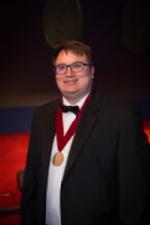
7 March 2018: Andrew Levan has been honoured in the inaugural Blavatnik Awards in the UK in a ceremony at the Victoria and Albert Museum in London. As one of three honourees across the breadth of Physical Sciences and Engineering, he is recognised for his role as a world leader in studies of the Universe using gamma-ray bursts and supernovae. The prize, presented by Sir Leonard Blavatnik is aimed at recognising outstanding research carried out by individuals under the age of 42. At 38, Andrew was the youngest honoree in Physical Sciences. Read the Warwick press release and more information on the Blavatnik Awards.
16 November 2017: Warwick Astronomers have joined the Sloan Digital Sky Survey (SDSS-V), making Warwick the first UK institution to be formally part of the project. Within SDSS-V, Boris Gaensicke will lead a spectroscopic survey of all stars within 100pc of the Earth - encompassing 350,000 systems, many of which are likely to host planetary systems. Read the Warwick press release and more information on SDSS-V.
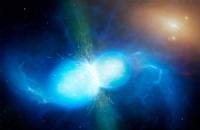
16 October 2017: Warwick Astronomers have led observations to capture the light from a gravitational wave source for the first time. The source was the merger of two neutron stars and the observations reveal such mergers to be the origins of heavy element formation in the Universe.
The Warwick press release is here, with further information in the BBC, ESO, NASA, Independent and Telegraph coverage, among others.
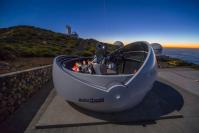 3 July 2017: Two telescopes were inaugurated at our La Palma Observatory facility. The Gravitational Wave Optical Transient Observer (GOTO) is searching for optical counterparts to gravitational wave sources and the Warwick 1m telescope (W1m) is a robotic telescope with a dual-arm imaging camera for follow-up observations. It is now in active operation following up triggers from the LIGO-VIRGO consortium
29 June 2017: The Astronomy and Astrophysics group have had another extremely successful round of applications for time on the Hubble Space Telescope, securing a total of 8 programmes in the recent Cycle 25 competition. Prof Boris Gaensicke will lead two programmes, one looking at the fates of planetary systems around stars very different to the Sun, and another investigating novae explosions. Prof Andrew Levan will lead 3 programmes, searching for counterparts to gravitational wave sources, mapping the regions around neutron stars with extreme magnetic fields, and investigating the link between gamma-ray bursts and extremely luminous supernovae. Three of our PhD students also been awarded time, Chris Manser will investigate the nature of debris discs around white dwarfs, Anna Pala will conduct detailed studies of a unique cataclysmic variable, and David Wilson will investigate the nature of stars that have survived orbiting inside each other's atmospheres.
01 October 2016: The Department of Physics at the University of Warwick, UK, seeks to appoint up to three academic posts in the area of Exoplanets, see the job add on jobs.ac.uk or on the AAS job register.
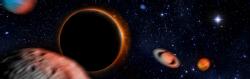 30 August 2016: The solar system could be thrown into disaster when the sun dies if the mysterious ‘Planet Nine’ exists, according to research from the University of Warwick.Dr Dimitri Veras in the Department of Physics has discovered that the presence of Planet Nine – the hypothetical planet which may exist in the outer Solar System - could cause the elimination of at least one of the giant planets after the sun dies, hurling them out into interstellar space through a sort of ‘pinball’ effect. Read the press release and the paper on arXiv.
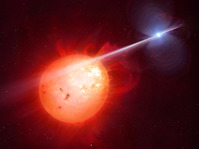
27 July 2016: A Warwick-led study published in Nature presents the discovery of a pulsar- like white dwarf binary. The system, which is known as AR Sco, emitts across the whole electromagnetic spectrum, all the while pulsing intensely on a two minute period. Read the press release, the paper on ArXiV or see the movie (and more). Image credit: Mark Garlick/University of Warwick.
25-29 July 2016: EuroWD16. The University of Warwick will host the 20th European White Dwarf Workshop. This meeting cover the structure and evolution of white dwarfs, as well as a wide range of astrophysical problems in which white dwarfs play a central role, such as SN Ia progenitors, the local star formation history, and evolved planetary systems.
7 Jan 2016: Out-of-Town RAS Meeting "The future of Astronomy and Planetary Science in the Ultraviolet". The University of Warwick will host an RAS 'Out of Town' meeting on Thursday 7th January 2016. This meeting will be on current UK research at Ultraviolet wavelengths, covering both planetary science remote sensing and astrophysics topics.
2015
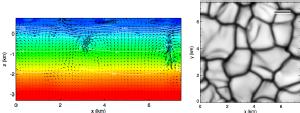 15 Dec 2015: Dr. Pier-Emmanuel Tremblay, Assistant Professor in Warwick, has been awarded a 1.5 million Euro Starting Grant from the European Research Council (ERC). The research project entitled "Evolution of white dwarfs with 3D model atmospheres" will soon recruit 1 PDRA and 3 PhD students to work on theoretical aspects of white dwarf research, in close connection with the observational work currently accomplished within the Warwick astronomy group.
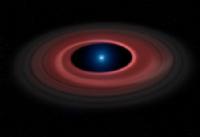
11 Nov 2015: Astronomers from Warwick University have captured for the first time and image of an asteroid being ripped apart by a dead star and forming a glowing debris ring. Read the Warwick press release, and the preprint from ArXiv. Image credit: Mark Garlick/University of Warwick.
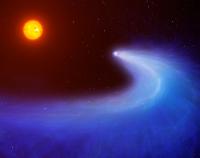 25 June 2015: Published in the journal Nature, a team including Warwick astronomer Peter Wheatley has discovered a giant comet-like tail of hydogren gas evaporating from a Neptune-sized exoplanet. The gas is thought to be boiled off by X-rays from the parent star and then swept away by radiation pressure. The tail was revealed in Hubble Space Telescope observations in which 56% of the star is covered by the tail in ultraviolet light. The planet is losing its atmosphere at a rate of 1000 metric tonnes per second, having narrowly escaped total evaporation by the intense X-ray irradiation it suffered when its parent star was young and active. Read the Warwick press release, the full journal article in Nature, or the preprint from ArXiv. Image credit: Mark Garlick/University of Warwick.
See for example coverage by the Washington Post, and the Daily Mail.
24 June 2015: The Warwick astronomy group has been very successful in the latest round of time allocation on the Hubble Space Telescope, and will lead six projects in the forthcoming Cycle 23, including a 67-orbit GO program and a 75-orbit snapshot program: Boris Gänsicke (An HST legacy ultraviolet spectroscopic survey of the 13pc white dwarf sample and The frequency and chemical composition of rocky planetary debris around young white dwarfs: Plugging the last gaps), Mark Hollands (The dawn of rocky planet formation), Andrew Levan (The late time behaviour and environments of the first gravitational wave transients), Chris Manser (A highly dynamical debris disc in an evolved planetary system) and Elizabeth Stanway (Understanding the star formation environment of a very low redshift, low luminosity, long Gamma Ray Burst). These observations were facing an oversubscription of approximately six to one.
7 May 2015: A research team led by Warwick astronomers Roberto Raddi and Boris Gänsicke have found that water delivery via asteroids or comets is likely taking place in many other planetary systems, just as it happened on Earth. Read the Warwick press release and the paper in the Monthly Notices of the Royal Astronomical Society.
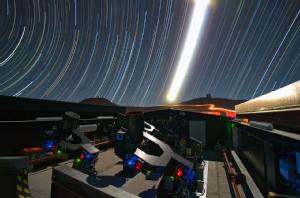 14 January 2015: Warwick astronomers have begun searching for small planets around bright stars using an array of twelve robotically-controlled telescopes. The telescopes, which form a wide-field observing system called the Next Generation Transit Survey (NGTS), are designed to detect the slight dimming of a star when a planet passes across its face. The NGTS team aims to find planets the size of Neptune down to twice the size of the Earth. Dr Peter Wheatley, one of the NGTS project leaders, said "The NGTS discoveries, and follow-up observations by telescopes on the ground and in space, will be important steps in our quest to study the atmospheres and composition of small planets such as the Earth.”
Read more in press releases from ESO and Warwick.
See also regional BBC News coverage.
Image: ESO/G.Lambert
 2014
2014
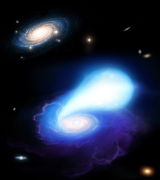
08 August 2014: A research team led by Warwick astronomers Joe Lyman and Andrew Levan have investigated the locations of peculiar 'calcium-rich' supernovae, which are often seen to explode at huge distances from any nearby galaxy. They postulate the merger of white dwarf-neutron star binary systems 'kicked' from their galaxy may explain these remote locations. The Warwick press release can be found here.
22 July 2014: The Warwick astronomy group is hiring two postdocs, see the AAS job register entries 48530 and 48532.
24 June 2014: The Warwick astronomy group have had another extremely successful round on the Hubble Space Telescope. Boris Gänsicke, Andrew Levan, Joe Lyman, Danny Steeghs and David Wilson will be leading a total of six programs on HST in the forthcoming Cycle 22.
2013
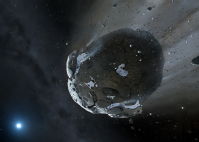
11 Oct 2013: Warwick astronomer Boris Gänsicke has been involved in the discovery of the remnants of a water-rich asteroid. The debris is orbiting the the white dwarf GD61, which is the burnt-out core of what was once a normal star, somewhat more massive than the Sun. Read the Warwick press release and the paper in Science (available on arxiv).
16 Apr 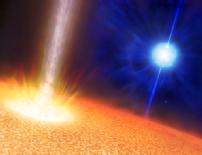 2013: A team, led by Warwick astronomer Andrew Levan has announced the discovery of a new type of gamma-ray burst, lasting for several hours, and possibly created by the collapse of a supergiant star. See here for more information.
17 Jan 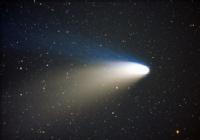 2013: Warwick astronomer Don Pollacco appeared on the BBC Radio 4 programme In Our Time with Melvyn Bragg discussing comets.
11 Dec 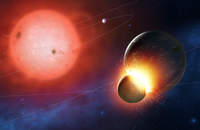 2012: Warwick astronomer Boris Gänsicke has been awarded an Advanced Grant by the European Research council, worth nearly 2.3 million Euro. This grant will fund a research group of several postdoctoral researdh assistants and postgraduate students to study a wide range of topics related to the end states of stellar and planetary evolution.
22 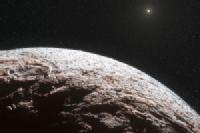 Nov 2012: Published in the journal Nature, Warwick astronomer Tom Marsh has helped to show that the dwarf planet Makemake has no atmosphere. Observations with the high-speed camera Ultracam showed that light from a distant star was blocked out abruptly by the dwarf planet, which lies in the outer reaches of our Solar System. If Makemake had an atmosphere like the dwarf planet Pluto then the light from the star would have faded gradually. The difference between these icy dwarf planets shows just how much we still have to learn about these mysterious objects. Read the Warwick press release, or the full journal article in Nature. Image credit: ESO/L. Calçada/Nick Risinger (skysurvey.org).
28 June 2012: 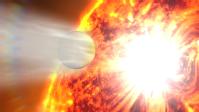 Warwick astronomer Peter Wheatley has used the NASA Swift spacecraft to detect a dramatic stellar flare that seems to have driven off part of the atmosphere of the exoplanet HD189733b. The Jupiter-like planet was blasted with 3 million times the X-ray radiation received by the Earth during an X-class flare, and observations with the Hubble Space Telescope eight hours later detected a flow of hydrogen gas escaping the planet. A previous observation with HST had not shown any evaporation.
NASA movie and images
ESA movie and images
Warwick press release
Journal article
7 June 2012: The Warwick astronomy group has been very successful in the latest round of time allocation on the Hubble Space Telescope. Boris Gänsicke, Andrew Levan, Danny Steeghs and Peter Wheatley will be leading six programs on HST in the forthcoming Cycle 20 (12869, 12870, 12899, 12920, 13025, 13026), including one of the five large programs that were awarded. Their projects were facing an oversubscription of six to one.
30 May 2012: 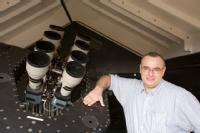 We are delighted to announce that Prof Don Pollacco will be joining our Astronomy and Astrophysics Group from September 2012. Don is a world leader in the search for planets around distant stars. He played a crucial role in developing the SuperWASP project, which has found more than a third of all known transiting planets and was awarded the Royal Astronomical Society Group Achievement Award in 2010. Don recently took part in NASA's Senior Review of its astrophysics space missions, and has been heavily involved in an advisory capacity with both the Science and Technology Facilities Council (STFC) and UK Space Agency (UKSpA) for many years. Don is also co-PI of the Next Generation Transit Survey
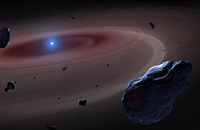 3 May 2012: Using the Hubble Space Telescope, members of the Warwick Astronomy group have measured the chemical abundances of planetary debris around white dwarfs, finding that the debris is mainly composed of Si, O, Mg, and Fe, and strongly depleted in C. This abundance pattern is very similar to that of the bulk Earth, demonstrating that the debris discs are made up of rocky material, the left-over of a planetary system that once orbited the progenitor of the white dwarf. Read the Warwick press release, or the paper on arXiv.
28 Feb 2012: The initial data release catalogues of our Kepler INT survey are now available. The KIS survey is a deep 5-filter optical survey of the Kepler field, obtained with the Isaac Newton Telescope by the IPHAS and UVEX survey teams.
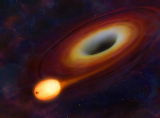 16 June 2011: Writing in the journal Science, an international team led by Warwick astronomer Andrew Levan have shown that a luminous gamma-ray and X-ray event originates from the nucleus of a distant galaxy, from the shredding of a star by the supermassive black hole at the galaxy core. Full details can be found at the here, and the paper can be read online at Science.(Image: University of Warwick/Mark Garlick).
25 May 2011: Discovery of the most distant explosion. Members of the Warwick Astronomy group have found the most distant explosion, possibly the most distant object, ever seen. The event, a gamma-ray burst named GRB 090429B appears to lie at a redshift of 9.4, or a distance of 13.16 billion light years, 96% of the way back to the big bang. More information can be found at here and the preprint can be found at arXiv.
25 May 2011: A deeply eclipsing double-white dwarf binary. Warwick astronomers have discovered a binary star which is made up of two white dwarfs that undergo mutual eclipses every 2.78 hours. This star, dubbed CSS 41177, is only the second eclipsing system found so far among the ~50 known double-white binairies. Because accurate stellar masses and radii can only be measured in eclipsing binaries, CSS 41177 provides an excellent opportunity for testing, and improving, our understanding of the structure of white dwarfs. The current data demonstrates that both white dwarfs in CSS 41177 have a core made out of helium. Over the next ~1Gyr, the orbital period of CSS 41177 will decrease because of the emission of gravitational wave radiation, and eventually the two white dwarfs will merge. As their combined mass is below the Chandrasekhar limit, they will not detonate, but form a subdwarf star, that will finally evolve into a single, rather massive white dwarf. See the Warwick press releases for more info and read the full article on arXiv.
4 Jan 2011: A warm welcome to Elizabeth Stanway, who joins the astronomy and astrophysics group as assistant professor. Elizabeth has a strong programme of research studying high redshift galaxies.
9 December 2010: Discovery of first carbon-rich planet reported in Nature this week.
Warwick astronomer Peter Wheatley has contributed to the discovery that the atmosphere of the exoplanet WASP-12b is dominated by molecules containing carbon, such as methane, while oxygen-based molecules such as water are missing. The discovery shows that there is a much greater diversity in planet composition that previously expected. Rocky planets with a similar composition could have mountain ranges made of diamonds, while minerals such as sand, that are common on Earth, would be very rare. Read the Nature article, the open-access version on arXiv, or listen to a BBC local radio interview with Peter Wheatley.
September 2010: We hosted the STFC Introductory Summer school for new Ph.D students, please navigate to the summer school pages for more information.
9 June 2010: Five HST programs for the Warwick Astronomy & Astrophysics group. The results of the Cycle 18 competition for observing time on the Hubble Space Telescope were announced last night, and five Warwick-lead programs were approved, the largest number for any University in the UK. This is an extraordinary achievement, given that the orbit-oversubscription in this round of proposals was close to nine. Tom Marsh is leading a programme to establish the evolutionary history of a remarkable pair of white dwarfs that should not exist according to all current models of their formation. Boris Gänsicke is leading a programme to determine an accurate temperature and mass for a white dwarf thought to be the progeny of an intermediate-mass star that barely failed to undergo a core-collapse supernova, he is also leading a programme to investigate the frequency of remnants of planetery systems around white dwarfs. Andrew Levan is leading a programme to unveil the birthplace and origin of one of the most extreme, and highly magnetic objects known in the Universe, as well as a programme that will use the power of gamma-ray bursts as lighthouses to study distant galaxies in unprecedented detail.
1 May 2010: Faculty position in the Astronomy & Astrophysics group. As part of the Midlands Physics Alliance, which supports collaborative research and graduate teaching across the neighbouring universities of Birmingham, Nottingham and Warwick, we are expanding the Astronomy & Astrophysics group. We will appoint a faculty member at the Assistant Professor or, exceptionally, Associate Professor level (more details).
17 November 2009: Ticking Stellar Time Bomb Identified. Using adaptive optics technology, astronomers studied the first helium nova explosion on the surface of a white dwarf some 25,000 light-years away. The exquisite spatial resolution reveals an expanding shell which permits the determination of the distance to the object, while spectroscopy shows that there is no sign whatsoever for hydrogen, the most common element in the universe. See the ESO and Warwick press releases for more info, images and movies, and some coverage on the BBC.
13 November 2009: Warwick astronomers discover two white dwarfs with oxygen-rich atmospheres. These unusual abundances imply that the two stellar remnants most likely descend from relatively massive progenitors that just failed to collapse into neutron stars. Read the Warwick press release and the article in Science (or the open-access copy on arXiv).
29 October 2009: The most distant object in the Universe: The discovery of a gamma-ray burst from an era when the Universe was only 600 million years old has been reported in Nature today. This discovery dramatically increases the record for the most distant object from a redshift of z=6.96 to z=8.2. For more information see the Nature video.
27 August 2009: Reported in Nature this week; the WASP project discovers a planet that shouldn't exist! The planet is ten times heavier than Jupiter, but orbits its star in less than one Earth day. Strong tides should have caused the planet to spiral into its parent star. For more information please see the Warwick press release and Nature's editor's summary.
10 March 2009: Warwick undergraduate finds evidence for a lost population of planets. In a paper accepted for publication in the journal MNRAS, Tim Davis reports results from his final-year undergraduate research project suggesting that a large population of planets orbiting close to their parent stars have been evaporated to destruction by intense stellar X-ray emission. The work was supervised by Peter Wheatley of the Astronomy and Astrophysics group, and is the article is available as a preprint or directly from the journal.
19 September 2008: Warwick astronomers lift the mystery of a unique optical transient. An unusual optical transient was identified during the the Hubble Space Telescope Cluster Supernova Survey brightened by a factor 120, and faded again into oblivion, over the course of ~200 days, but its nature remained completely unknown. Warwick astronomy staff have shown that the spectrum of this transient is consistent with a cool, carbon rich photosphere at a redshift of ~0.14. In addition, they analysed XMM-Newton X-ray observations of the transient, showing that it was not only bright at optical wavelengths, but also a luminous high-energy source. The extragalctic nature of this event suggests that it may be a so far unknown type of supernova. For more information read the paper submitted to the Astrophysical Journal Letters or the news item in Nature.
10 April 2008: Hubble pinpoints the brightest explosion. Researchers working at the University of Warwick, with colleagues in Leicester University, ESA and NASA, have used NASA's Hubble Space Telescope to pin point what remains of what was the brightest naked-eye object ever seen from Earth. It is 7.5 billion light-years away -- halfway back to the big bang, and was once as bright as 10 million galaxies. More information and images from NASA.
24 Dec 2007: TIME Magazine ranks new WASP planets in Top 10 Scientific Discoveries of 2007. In October the UK-led WASP project, including Warwick participation, announced the discovery of three new planets orbiting distant stars. This result has been rated by TIME Magazine in the Top 10 of Scientific Discoveries in 2007. For more information read the TIME article on WASP and the full list of Top 10 Scientific Discoveries. Also see the original STFC press release.
19 Dec 2007: Thousands sign Downing Street petition against planned cuts to funding of Astronomy and Particle Physics. In a matter of hours, thousands of shocked scientists and supporters today petitioned the Prime Minster to reverse the decision to cut vital UK contributions to Particle Physics and Astronomy. For more information see the petition webpage.
10 Dec 2007: Warwick astronomers contribute to largest digital survey of the Milky Way. The IPHAS consortium, led from the UK, with partners in Europe, USA, Australia, has released today the first comprehensive optical digital survey of our own Milky Way. Conducted by looking at light emitted by hydrogen gas, using the Isaac Newton Telescope on La Palma, the survey contains stunning images of nebulae and stars. For more information see the STFC press release and the IPHAS webpage.
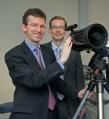 24 Aug 2007: Warwick astronomer selected by the Royal Society for MP-Scientist Pairing Scheme. STFC advanced fellow and assistant professor Danny Steeghs will be paired with Jeremy Wright, MP for Kenilworth and Rugby, as part of a Royal Society scheme aiming to "build bridges between some of the best research workers in the country and members of the UK parliament". Danny will spend a week in Westminster, followed by reciprocal visits to the University and constituency office. Full details of the scheme are available from the Royal Society.
26 Apr 2007: Warwick astronomers work with undergraduate student to measure the gravitational fields of extra-solar planets. In a paper accepted for publication in the journal MNRAS, John Taylor and Peter Wheatley worked with Giles Sans, a Warwick MPhys project student, to develop a new method for determining the surface gravities of transiting planets. They found that giant planets orbiting close to their stars have weaker surface gravity than Jupiter. The method is much more precise than previous methods and also does not depend on assumptions about the nature of the parent star. A pre-print of the paper can be viewed on astro-ph.
22 Dec 2006: Published in Science: Warwick astronomers discover a disc of metal-rich gas orbiting a white dwarf star. The disc probably orginates from a disrupted asteroid in a planetary system. Further details...
8 Dec 2006: Published in Science: Warwick astronomers use ULTRACAM observations to confirm for the first time the existence of brown dwarf donor stars in cataclysmic variables. Further details...
8 Dec 2006: We are pleased to announce that Danny Steeghs will be joining our group as assistant professor from April 2007.
17 Oct 2006: We are pleased to announce that Andrew Levan will be joining our group as assistant professor from Jan 2007.
12 Oct 2006: Congratulations to Amornrat Aungwerojwit on winning the Anglo-Thai Society Annual Award for Educational Excellence in Science & Medicine.
26 Sept 2006: SuperWASP discovers two transiting extra-solar planets