Penélope Longa Peña
I am a PhD candidate in the Astronomy and Astrophysics group at the University of Warwick. My supervisors was Dr Danny Steeghs.
I'm currently studying orbital parameters of Compact Binary Stars.
Most stars in the Galaxy are found in multiple systems. In close binaries stars, the evolution of one star affects its companion. Evolutionary expansion of stars allows for a mass exchange between the components.
In most cases, the material from the donor star forms an accretion disc around the heavier but more compact companion.
Energy and angular momentum are continuously carried outside the disc by viscous stresses, tides interaction, magnetic fields and gravitational radiation. Because of this, close binary stars consisting of compact stellar remnants (white dwarfs, neutron stars , or black holes) are considered as primary targets for gravitational waves detection.
Knowledge of compact binaries parameters is crucial to develop models that help us to understand the behaviour of the systems. The astronomical advances of our time have enabled us to statistically quantify the behaviour and evolution of variable stars.
This would not have been possible without knowledge of basic properties, such as the masses of binary components, inclination angles and orbital periods of individual systems on specific cases. Working with individual binary stars gives us the opportunity to improve existing models of their dynamics and evolution, improving the accuracy of their parameters and obtaining as much information on each.
Cataclysmic Variable Stars:
Cataclysmic Variable stars (CVs) are semi-detached binary systems consisting of a white dwarf (primary star) and a less massive main sequence star (secondary star), with an orbital period usually between 80 and 700 minutes. Between these two stars there is material transfered from the secondary to the primary, but due to conservation of angular momentum, the material does not fall directly on the surface of the primary and it forms an accretion disc around it. The transferred material hits the outer edge of the disc. This creates a bright spot, which emits up to approx 30% of the total luminosity of the system. CVs provide us an unique environment to study two major processes: accretion discs and binary star evolution. They are our greatest sources of information about the process of accretion, which is key to understanding since the formation of new planets to the energetic quasars.
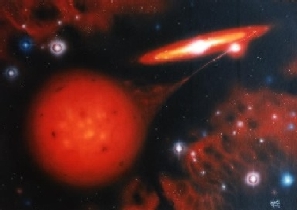
Cataclysmic Variable Star, by Mark A. Garlik
Low-Mass X-Ray Binaries:
Low-Mass X-ray binaries (LMXBs) stars are formed by a X-ray emitter primary star that can be a neutron star or a stellar mass black hole and a donor star with masses below 1.5Msun. In this systems, the compact star accretes material from the donor mostly by Roche lobe overflow (like CVs). LMXBs are typically found in the bulge and disc of the Milky Way, and observations suggest that there may be thousands of black hole LMXBs in our Galaxy. However, there are only 23 confirmed black holes and there is not a single low mass black hole among these. This lack of low mass black hole binaries may be an observational effect.
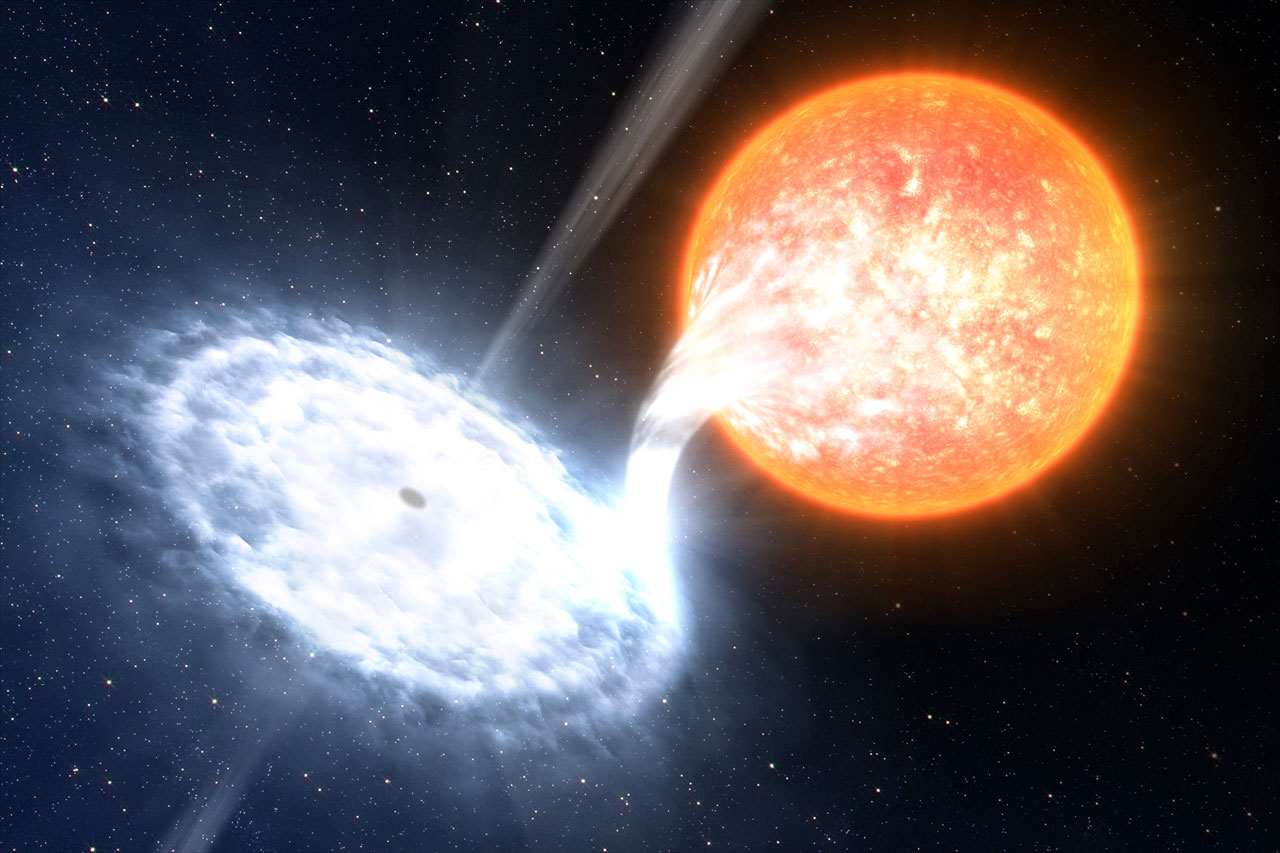
Black Hole Binary, by ESO/L. Calçada.
Write to:
Penélope Longa Peña,
Department of Physics,
University of Warwick,
Coventry CV4 7AL
UK
Contact details:
Office: PS 004
E-Mail: p.a.longa-pe-a@warwick.ac.uk or
penelope.longa@gmail.com