
Danny Steeghs
Professor and head of the Astronomy & Astrophysics group within the Department of Physics at the University of Warwick.
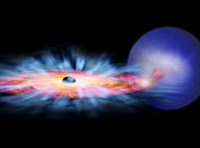 My research interests focus on compact objects; the remnants of stars in the form of white dwarfs, neutron stars and black holes. Binaries involving one or more compact remnants offer spectacular laboratories for a broad variety of astro-physics. Such binaries are responsible for spectacular explosions and are principal source of gravitational waves. I am interested in the astrophysics enabled through gravitational waves as well as what can be learned from combined GW & electromagnetic information, aka multi-messenger astronomy.
I am an observationally focused astronomer, exploiting the spectrum of facilities available to us, both from the ground as well as space. I am currently leading a new facility that will hunt for EM signatures of binary mergers, called the Gravitational wave Optical Transient Observer (GOTO).
If you are interested in a Ph.D position in our group, a description of current projects on offer can be found here.
Team
- Krzysztof Ulaczyk (research fellow)
- Joe Lyman (future leader fellow)
- Kendall Ackley (research fellow)
- Amit Kumar (research fellow)
- Thomas Killestein (PhD student)
- Ben Godson (PhD student)
Research
- Latest preprints as posted on arXiv or full publication list (via on-line ADS search)
- GOTO ; Gravitational Wave Optical Transient Observer
- The Kepler INT Survey of the Kepler field
- The IPHAS survey
- public data: early data release, do a cone search
- images: IPHAS gallery / Nick Wright's pictures
- project pages [need password]: Warwick node / Cambridge node
- project data [need password]: CfA:MMT Hectospec follow-up ; FLWO FAST spectroscopy ; CASU catalogs
- Warwick icast programme on IPHAS
- The helium-nova V445 Puppis, or as some people prefer to call it, a ticking stellar time bomb. Watch the expanding shell as resolved by adaptive optics, an artist impression of the binary system and some media coverage by the BBC, Scientific American.
- Two white dwarfs going round in 5.4 minutes, it can't get much more cosier than that ....

Write to:
D.Steeghs,
Department of Physics,
University of Warwick,
Coventry CV4 7AL
UK
Contact Details:
Office: Millburn House F.049
Tel: +44 (0)247 657 3873
E-Mail:
D.T.H.Steeghs(at)warwick.ac.uk
 0000-0003-0771-4746