
Laboratory Measurements
Our laboratories here at Warwick are well equipped for the study of superconducting and magnetic materials.
Magnetic Measurements
We have established a Centre for Magnetic Measurements based in the laboratories of the Superconductivity and Magnetism Group here in Physics Department at the University of Warwick. The magnetometers and susceptometers described below are used to make measurements on a wide range of magnetic materials.
Research scientists from many different disciplines including Physics, Biology, Chemistry and Materials Science have already taken advantage of these facilities. Some of the users are from Departments here at Warwick, while others are based at other UK HEI's or research centres.
If you think that studies of the magnetic properties of your samples may be of help in your work, please contact Martin Lees to discuss the possibility of collaborating.
|
|
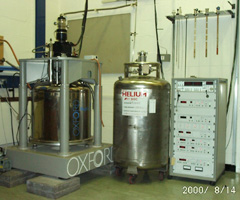
Oxford Instruments Vibrating Sample MagnetometerWe have an Oxford Instruments vibrating sample magnetometer (VSM) with a 12 tesla superconducting solenoid. The VSM can operate between 1.4 and 300 K using a standard Variable Temperature Insert (VTI).
|
|
| Oxford Instruments MagLab VSM with 12 T magnet and 1.4 to 320 K VTI. The photograph shows the cryostat on the left mounted inside its vibration isolation frame. To the right of the picture is the instrument rack. |
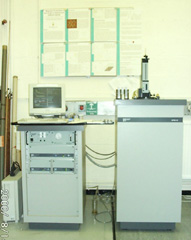
Quantum Design MPMS-5S SQUID MagnetometerOur 50 kOe (5 T) Quantum Design MPMS-5S SQUID magnetometer is used to make high sensitivity DC magnetisation measurements in the temperature range 1.8 to 400 K (800 K with oven). This instrument has a resolution of 5 x 10⁻⁸ emu. The system has recently been upgraded to include the Ultra-Low Field Capability (±0.05 G), an environmental shield, and the SQUID AC Susceptibility measurement option - 0.1 Hz to 1 kHz with a sensitivity of 2 x l0 -8 emu at 0 G. The system has the continuous low temperature and temperature sweep options.
|
|
|
easyLab Mcell 10We have an Almax easyLab Mcell 10 high-pressure cell for carrying out dc magnetisation measurements under pressures of up to 1 GPa in our SQUID magnetometer. The single walled hydrostatic cell has a pressure volume of 1.9 mm diameter by 10 mm length. The pressure is monitored in-situ using a Sn manometer.
|
Quantum Design MPMS-5S SQUID magnetometer with 5 T magnet, RSO and continuous low temperature option. |

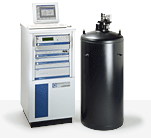
Quantum Design MPMS-XL SQUID MagnetometerWe have a 70 kOe (7 T) Quantum Design MPMS-XL SQUID magnetometer. This instrument has longitudinal and transverse moment detection system and sample rotators. I is used to measure d.c. magnetisation the temperature range 1.8 to 400 K (800 K with oven) and has a resolution of 5 x 10⁻⁸ emu. The magnetometer has the continuous low temperature, temperature sweep, and reciprocating sample options. Our easyLab Mcell 10 pressure cell can also be used in this system. |
|
|
IQuantum iHelium3 low temperature insertWe have a IQuantum iHelium3 insert that extends the temperature range d.c. magnetisation measurements possible in out QD MPMS-XL magnetometer to less than 0.5 K. The specifications of the iHe3 system are as follows: |
 |
|
|
Quantum Design MPMS-XL SQUID magnetometer with 7 T magnet, transverse moment and continuous low temperature option. |

|
|
Quantum Design Physical Property Measurement System (PPMS)We have two Quantum Design Physical Property Measurement Systems (PPMS) Thermodynamic MeasurementsOne system has a P650 heat capacity option. Measurements of heat capacity can be made between 0.4 and 400 K in magnetic fields of up to 9 T. Samples with masses of between 5 and 500 mg can be measured with a resolution of 10 nJ/K @ 2.0 K. The system uses a 2 tau heat pulse-relaxation technique. For more information on the PPMS heat capacity system click here to view a PDF file of the Quantum Design Application Note Transport measurementsOur second system can be used to carry out AC and DC resistivity measurements (300 mK base) and collect 4 and 5 wire balanced Hall effect and I-V curves (1.8 - 400 K). For more information click here to view the Quantum Design electro-transport option note The thermal transport option allows measurements of thermal conductance, K, and Seebeck coefficient, S.
|
|
| The QD PPMS measurement system consisting of dewar with superconducting magnet and associated control electronics. |
|
|
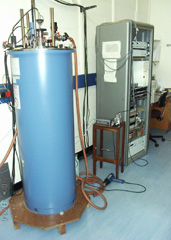
Oxford Instruments 9 - 11 T CryomagnetA 9 (11 with lambda plate) T Oxford Instruments superconducting magnet with inserts and instrumentation is available to carry out ESR and ultrasound measurements. Oxford Instruments 15 - 17 T CryomagnetAn Oxford Instruments 15 (17 with lambda plate) T magnet is available for transport measurements from 330 K down to temperatures as low as 0.3 K in magnetic fields up to 17 T. |
| Oxford Instruments 9 T magnet used to make ESR and ultrasound measurements in magnetic field. |  |
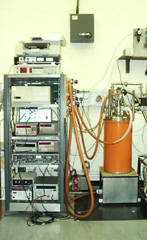
AC SusceptibilityWe have a low frequency (1 mHz to 300 Hz) ac magnetic susceptibility option in our QD MPMS-5S and a higher frequency (10 - 10 kHz) ACMS susceptometer in our 9 T PPMS, We can also in to perform ac susceptibility measurements at temperatures between 1.5 - 320 K in the frequency range 20 to 10000 Hz and where Hac < 100 Oe in a home built ac susceptometer. AS Products orange cryostatOne of our home built ac susceptometers uses an AS products 50 mm orange cryostat that operate between 1.5 K and room temperature
|
|
|
| One of our "Orange" cryostats. This is used to make ac susceptibility measurements between 1.5 K and room temperature. |
Linde Kryotechnic TCF10 Helium Liqufier |
|
|
The Physics Department has its own Linde TCF10 helium liquefier. This system is managed by the Superconductivity and Magnetism Group and provides liquid helium to all the research groups in the Department who use low temperature equipment. The TCF10 is a fully automatic computer controlled helium liquefier using turboexpanders and a screw compressor (Kaeser CSD82). The system includes an oil removal skid, built in drier and low loss purifier, and a pure gas buffer. In normal operation, the cold box can produce 11 litres of liquid per hour that is stored in a 1000 litre vessel for distribution in mobile dewars to our research laboratories. Recovery systems on each cryostat collect the helium gas which is stored in a 10 m3 balloon before being compressed into bundles of high pressure (300 bar) storage bottles by two recovery compressors (Bauer Verticus 5). |
 |