People
The Animation
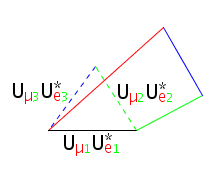 |
The NeO java application by Victoria Hamilton-Morris and Paul Harrison. This animation visualises neutrino flavour oscillations, in terms of a set of rotating quantum mechanical amplitudes. (Note - it may take a few minutes to download, the first time). |
The Experiment
One of the fundamental questions in physics is why there is more matter than anti-matter in the Universe. This asymmetry could be explained by a difference between neutrinos and their anti-matter partners, both of which are a part of a family of particles known as leptons. If neutrinos have mass, which is not predicted by the
Standard Model of particle physics, then they could oscillate between three different flavours - electron, muon and tau - as they propagate through space. The oscillations could then produce CP-violation effects, which will generate an asymmetry between matter and anti-matter. Measurements of neutrino oscillations by
T2K and other experiments imply that neutrinos have mass, and further measurements are required to fully explore the physical properties of the neutrino. The ideal way to do this is to use a
Neutrino Factory, which will produce an intense beam of neutrinos which will be used to make precise measurements of the parameters describing neutrino oscillations and CP-violation for leptons. These measurements will give a more complete picture of CP-violation and how it can generate the observed matter - anti-matter asymmetry in the Universe. The UK is taking a prominant role in research and development (R&D) activities for a Neutrino Factory, which could be built in the UK at the
Rutherford Appleton Laboratory (RAL). A simplified layout of the facility would be that shown
below, in which the intense neutrino beam would be produced from the decay of muons in the last element of the accelerator complex. The design would involve the following elements:
- Proton Driver
- Pion Production Target
- Muon Cooling
- Muon Acceleration
- Muon Storage Ring

The first stage of the factory design involves a
proton driver system, in which negative hydrogen ions (H
-) are produced by a thermionic (plasma) emission source and then passed through an early acceleration stage to produce a beam of ions with energies of approximately 0.15 GeV every 50 seconds (frequency of 50 Hz). The ions pass through a thin carbon or aluminium oxide foil to strip two electrons to create protons. The protons are then passed through
rapid cycling synchrotons (RCS) until they reach an energy around 5 GeV, in bunches with an average time duration of 2 nanoseconds. The 4 MW proton beam is smashed against a target to produce pions. The target needs to be robust enough in order to withstand the extremely high power density of the proton beam. The pions then decay to muons, which are then "cooled" so that the muon beam is reduced in size to fit inside the accelerator components further downstream. The
Muon Ionisation Cooling Experiment (MICE) is being constructed at RAL to demonstrate that muon cooling will be possible for a Neutrino Factory. The muons are then accelerated and stored inside a racetrack or triangular-shaped storage ring, where they will eventually decay into electrons and neutrinos after a thousand turns or so. The neutrinos that are produced will travel along the straight sections of the storage ring (represented by the green dotted arrows in the above figure), essentially at the speed of light. These sections need to point to the underground laboratories where the neutrino detectors would be located. Possible sites for these detectors are
Japan (Kamioka), the USA (
Soudan mine in Minnesota or the
Homestake mine in South Dakota), or Europe (
Gran Sasso in Italy or
Boulby in England). Studies indicate that approximately 10
21 muon decays per year are required to deliver the physics programme, which in turn requires that the Neutrino Factory contain technologies beyond what is presently available, creating the need for an extensive period of R&D.
Research activities
The research that Warwick University is directly involved in is the design of the front-end test stand, which is being built at RAL to test the chosen technologies for the proton driver, as well as optimising the production
yields of pions and muons for a Neutrino Factory target system. The Warwick group is also working on the
Muon Ionisation Cooling Experiment (MICE) that will verify whether a beam of muons can be cooled (reduced in size) as it passes through a series of absorbers and radio-frequency (RF) accelerator cavity sections.
Theses and alumni
- David Adey thesis: "Beam instrumentation and investigations into muon cooling at MICE"
- Celeste Pidcott thesis: "Multiple scattering and particle identification in the Muon Ionisation Cooling Experiment"
- Krishnan Rama thesis: "Fermion flavour observables : renormalisation invariants and model building using discrete symmetries "
- Ian Taylor, former MICE researcher, now working in industry
