
CIBB Workshops
Third two-day workshop of the CIBB Project ('Contemporary Issues in Bioethics and Biopolitics')
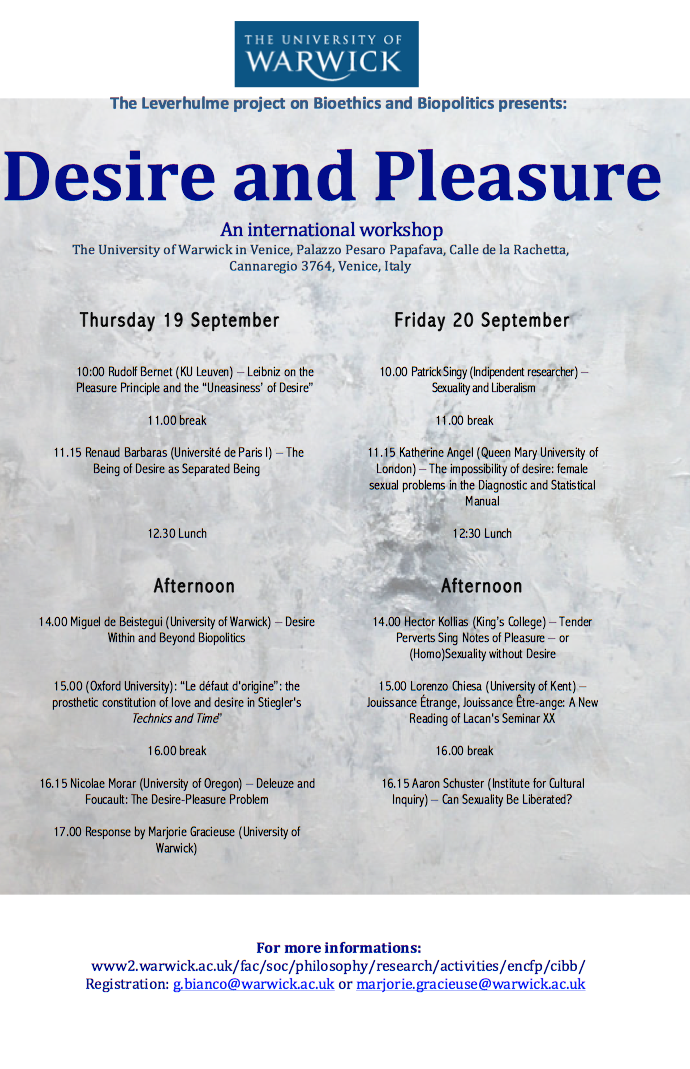
The Leverhulme project on Bioethics and Biopolitics presents: Desire and Pleasure An international workshop The University of Warwick in Venice, Palazzo Pesaro Papafava, Calle de la Rachetta, Cannaregio 3764, Venice, Italy Thursday 19 September 10:00 Rudolf Bernet (KU Leuven) – Leibniz on the Pleasure Principle and the “Uneasiness’ of Desire” 11.00 break 11.15 Renaud Barbaras (Université de Paris I) – The Being of Desire as Separated Being 12.30 Lunch Afternoon 14.00 Miguel de Beistegui (University of Warwick) – Desire Within and Beyond Biopolitics 15.00 (Oxford University): “Le défaut d'origine”: the prosthetic constitution of love and desire in Stiegler's Technics and Time” 16.00 break 16.15 Nicolae Morar (University of Oregon) – Deleuze and Foucault: The Desire-Pleasure Problem 17.00 Response by Marjorie Gracieuse (University of Warwick) Friday 20 September 10.00 Patrick Singy (Indipendent researcher) – Sexuality and Liberalism 11.00 break 11.15 Katherine Angel (Queen Mary University of London) – The impossibility of desire: female sexual problems in the Diagnostic and Statistical Manual 12:30 Lunch Afternoon 14.00 Hector Kollias (King’s College) – Tender Perverts Sing Notes of Pleasure – or (Homo)Sexuality without Desire 15.00 Lorenzo Chiesa (University of Kent) – Jouissance Étrange, Jouissance Être-ange: A New Reading of Lacan's Seminar XX 16.00 break 16.15 Aaron Schuster (Institute for Cultural Inquiry) – Can Sexuality Be Liberated?
This two-day workshop is free and open to all, but please register your interest in attending the workshop with Marjorie Gracieuse: marjorie.gracieuse@warwick.ac.uk or on our facebook page
The workshop will take place at the Palazzo Papafava in Venice, property of the University of Warwick. Directions to the Palazzo Papafava
Accommodation (please contact the hotel directly, we advise you to book your room asap to avoid disappointments)
Please note that all the papers will be delivered in English.
This workshop is funded by The Leverhulme Trust.
Second two-day workshop of the CIBB Project ('Contemporary Issues in Bioethics and Biopolitics')
Open to the public FREE of charge.
(you are advised to register your interest in attending the workshop with Marjorie Gracieuse at m.gracieuse@gmail.com)
Please note that all the papers will be delivered in English.
This two-day workshop will take place at the Palazzo Papafava, Calle de la Rachetta Cannaregio 3764, 30121 Venezia Italy.
Directions to the Palazzo Papafava
Accommodation (please book with the hotel directly).
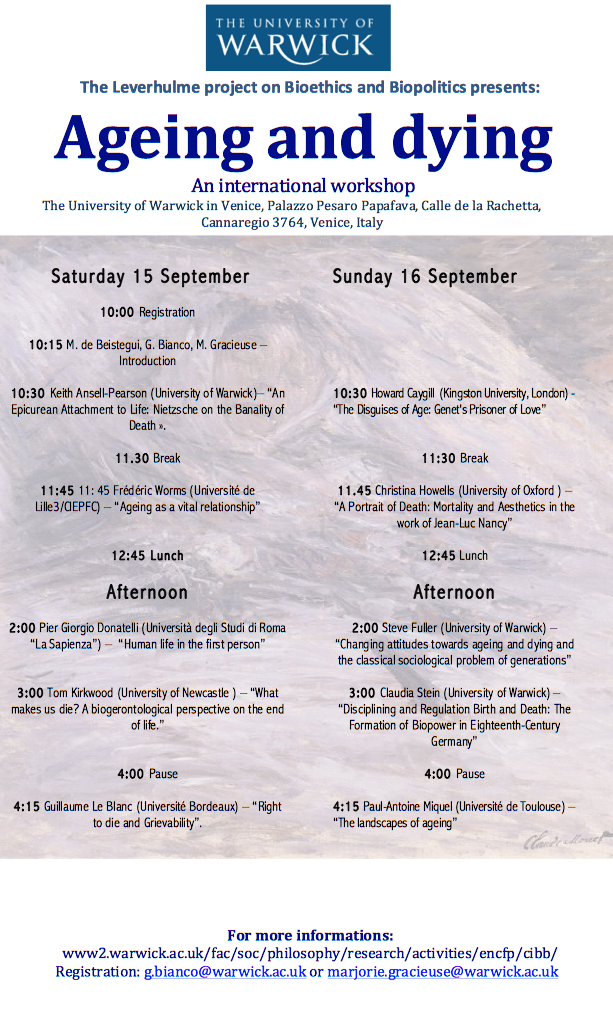
Human life is mortal life. This ontological claim, in turn, presupposes an epistemological, ethical, and political revolution: if death is not simply outside life, but creates a tension within life itself, then death itself needs fully to be integrated within our lives, private and public, individual and political. There needs to be a politics of birth, death and ageing, as well as an epistemology of life. This is precisely the point at which the stakes of biopolitics emerge. Life itself falls within structures of power and becomes a political object as soon as it becomes a question of preserving it from its other, namely, death. In order to better preserve and protect individual and species’ life, an increase and extension of governmentality is required. It is under these conditions that the ‘politics of life’ tend to become both bio-politics and thanatopolitics. The intrinsic risk is one in which, in order to address those problems, biopowers need to decide and legislate on what can be considered as ‘truly’ alive, and establish a rigid and normative hierarchy, with human life in its actual existence at the top of the scale, and other living beings as inferior forms of life. This situation generates questions of ethics and jurisprudence that deserve to be explored in depth.
The CIBB project members: Giuseppe Bianco, Marjorie Gracieuse, Miguel de Beistegui, Bill Fulford and Claudia Stein.
First two-day workshop of the CIBB Project ('Contemporary Issues in Bioethics and Biopolitics')
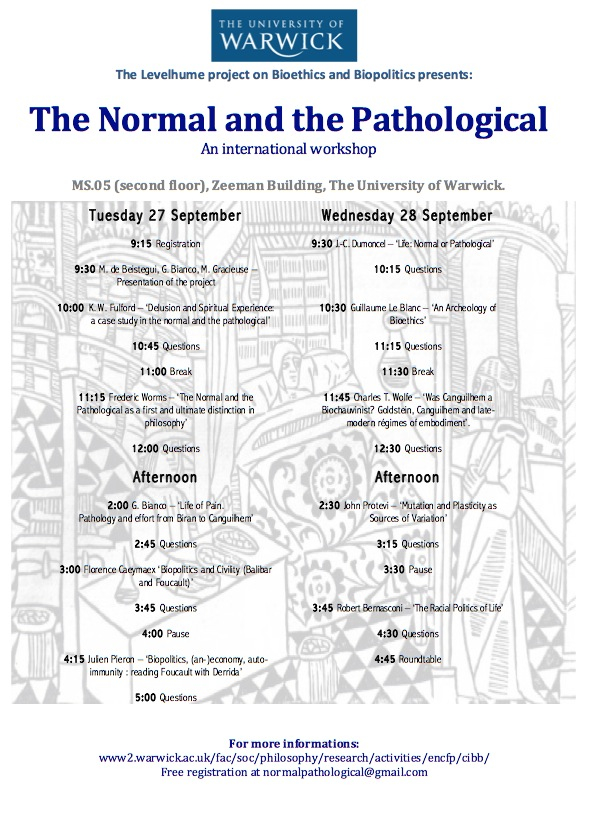
'The Normal and the Pathological'
27th and 28th September 2011
MS.05 (second floor) Zeeman Building, The University of Warwick.
Please note that all the papers will be delivered in English.
All welcome. Free registration at normalpathological@gmail.com
From a philosophical perspective, the problem of illness can be seen to emerge from the tension between the subjective (a life which is mine) and objective dimensions of life. On the one hand, illness is irreducible to an objective fact, as if independent of the subjectivity which it affects; on the other hand, it is irreducible to a mere signification, and cannot be understood independently of its inscription within a living organism, its relation to an environment, and even the effort, on the part of other living beings, to know and treat it. Illness is a qualitative and individual experience that takes place within human life itself. Once we recognise the specificity of illness in those terms, can we not arrive at an understanding of life, and the normal, on the basis of the pathological, and not as what is simply threatened and, ultimately, annihilated by it? Similarly, should medicine not recognize in care (and its latin etymology cura) the ethical implications of the internal tension of life and not isolate the pathology from the subjectivity in which it is rooted?
Far from being of interest only to biology and medicine, the question of the normal and the pathological implicates our perception of life as a whole, in all its forms. Pathology is at the source of all questioning concerned with life. It's only on the basis of suffering and distress, which are the signs of illness, that every question regarding life, or what living human beings consider normal at a given stage of their history, and the conditions under which such a state can be maintained, becomes possible. "Health is life in the silence of the organs," wrote Leriche. This means that all discourse of life on life spring from that obscure moment when, confronted with an obstacle, life "speaks" or seeks to speak. To the extent that our purpose is to ask about life, we need to begin by asking about life's relation to the pathological, and the epistemological, ethical and political implications of such a relation.
After the classical contributions of Canguilhem and Foucault, we are convinced that it is possible, and indeed necessary, to extend and adapt the reflection of the philosophy of pathology in the light of the new challenges emerging from the evolution of society and the life sciences. In the era of bio-power, the norms have become independent of the normative power of the human being, determining its comportments and excluding those considered pathological. To what extent is it possible to emphasise and promote the normative activity of human life in the face of a system that declares in advance, and down to the most minute details, what is normal? What paradigm of normality and health can we develop as an alternative to auto-immunisation, this disease caused by the excess of concern for health? What critical space is left, or can be generated, in an epoch in which the life sciences make it possible for the human being to intervene on itself, on other living beings, and determine their identity? Is it still possible to develop a normative critique that would not be rooted in the naturalistic paradigm?