
Berlin beats London and Washington in league table of world’s best democratic space
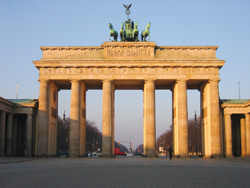 New research from the University of Warwick suggests that Berlin has the best democratic space in the world, topping a list that includes London, Washington and Tokyo.
The list appears in a new book, ‘Democracy and Public Space: The Physical Sites of Democratic Performance’ written by Dr John Parkinson, from the University of Warwick’s Politics and International Studies department.
Dr Parkinson carefully selected 11 capital cities and assessed how well they provide space for all kinds of democratic action. He visited Berlin, Washington, Ottawa, Canberra, Wellington, Hong Kong, Mexico City, London, Tokyo, Santiago and Cape Town.
He said: “In my book I have tried to answer the question, what makes for a good capital city from a democratic point of view? Even though revolutions and protests may be co-ordinated via Facebook and Twitter, they still involve real people who take up, occupy, share and contest physical space. Politics is still a physical pursuit, even in an online, interconnected world.”
Dr Parkinson looked at a number of criteria, including the accessibility of public buildings, but also the availability of public meeting space, parks and footpaths, public transport systems and more.
“I wanted to see not just how formal buildings like parliaments work, but how easy it is for citizens to perform democratic roles in those cities. Plenty of cities are good for shopping and tourism; democratic citizenship is harder.”
Berlin came top of the list because it ticked many of the boxes. Dr Parkinson attributes this to the city’s past as a symbolic battleground.
He said: “Berlin has been the site of so many battles over the use of public space for political purposes. Right now, battles continue over how far the city should go erasing the physical remnants of Cold War divisions. Even questions over sites like Tempelhof Airport, a Nazi-era building but an important symbol of the Berlin Airlift, are unresolved. But the very fact that people have these debates is healthy – it means Berliners are more likely to value space for expressly democratic purposes, and resist attempts to turn it over to purely commercial or leisure interests.”
Cape Town is bottom of the list largely because the public is heavily stratified there, the legacy of the apartheid era. Dr Parkinson also notes that in Washington DC the needs of heritage and tourism dominate the democratic spaces, such as the Congress building. “
London is placed eighth in the list because: “Comparatively, London is a ferociously expensive city to get around; its public spaces are policed to an extent unmatched except by Washington; and it is indulging in the privatisation of footpaths and roadways.”
The full list of cities:
- Berlin
- Wellington
- Ottawa
- Canberra
- Washington, DC
- Hong Kong
- Mexico City
- London
- Tokyo
- Santiago/Valparaiso
- Cape Town
Notes to editors
Democracy and Public Space: the Physical Sites of Democratic Performance, John R Parkinson, Oxford University Press
To speak to Dr Parkinson call him on 07762 729749 or email j.r.parkinson@warwick.ac.uk. Alternatively contact Kelly Parkes-Harrison, Press and Communications Manager, k.e.parkes@warwick.ac.uk, 02476 150868, 07824 540863.