
Massive explosion helps Warwick researcher spot Universe’s most distant object
An international team of UK and US astronomers have spotted the most distant explosion, and possibly the most distant object, ever seen in the Universe.
University of Warwick astronomer Dr Andrew Levan was one of the first members of that team to spot the exploding star, known as a Gamma-ray Burst (GRB), which was briefly as bright as several thousand galaxies (more than a million million times the brightness of the sun). This very bright explosion allowed it to be detected at an extreme estimated distance of 13.14 billion light years - putting it 96% of the way to the edge of Universe and making it most distant object ever seen.
The gamma-ray burst was first detected by NASA's Swift satellite in April 2009. The research team spent two years carrying out a careful examination of their data to see if the burst really was a record-breaker. “The more we examined this burst, the better it looked.” says Dr Andrew Levan.
Thanks to their extreme brightness, gamma-ray bursts can be detected by Swift and other satellite observatories even when they occur at distances of billions of light years. While the bursts themselves last for minutes at most, their fading "afterglow" light remains observable with large telescopes for days or even weeks. By performing a sophisticated analysis of this light, the research team were able to show that the burst most likely has a redshift (the means astronomers use to measure distance) of approximately 9.4. While there is some uncertainty due to the faintness of the source, this is significantly greater than the previous record holding GRB, which had a redshift of 8.2.
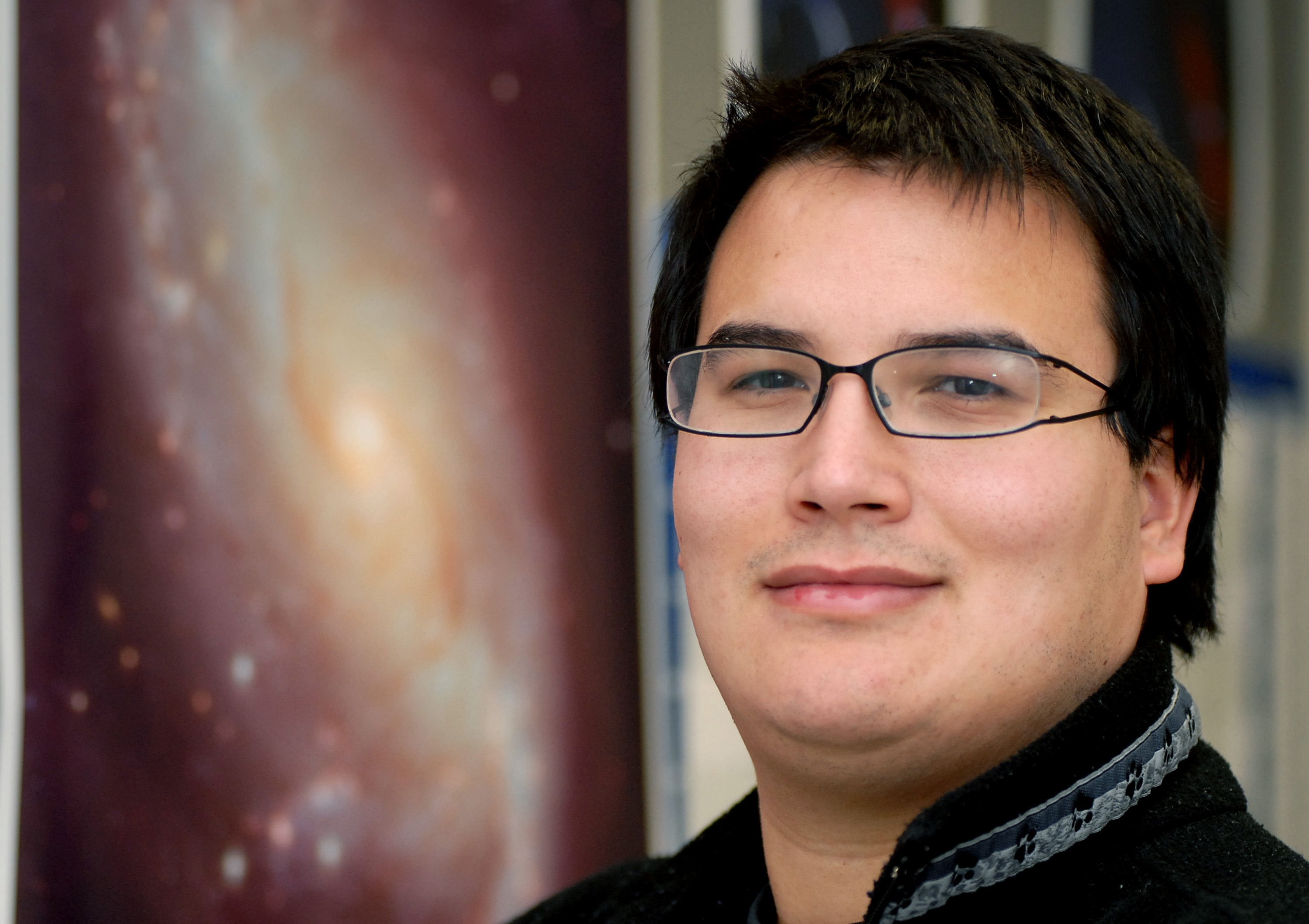 Dr Andrew Levan of the University of Warwick, one of the first people to observe the explosion and the second author of the paper, said:
"The race to find distant objects stems from the desire to find and study the first stars and galaxies that formed in the Universe, in the first few hundred million years after the Big Bang.”
“By looking very far away, because the light takes so long on its journey to reach the Earth, astronomers are effectively able to look back in time to this early era. Unfortunately, the immense distances involved make this very challenging. There are different ways of finding such objects, looking at distant galaxies being the most obvious, but because galaxies are faint it is very difficult. GRB afterglows are so much brighter”.
The researchers used the Swift satellite, the Gemini North Observatory and the Hubble Space Telescope
"This GRB shows us that there is a lot of action going on in the Universe which we can't currently see," Said Professor Nial Tanvir, from the University of Leicester and the leader of the
Hubble Space Telescope part this research programme, "Our observations show us that even
the Hubble Space Telescope is only seeing the tip of the iceberg in the distant Universe".
Swift is capable of finding some GRBs at distances corresponding to when the first stars are predicted in the Universe", said Prof Paul O'Brien a member of the Swift team at Leicester,
The research has been accepted for publication in the Astrophysical Journal in a paper entitled “Photometric Redshift of z ~ 9.4 for GRB 090429B. 2011” with former Penn State graduate student Antonino Cucchiara as first author and Dr Andrew Levan from the University of Warwick as its second author.
Notes for editors:
The Swift satellite is a joint US/UK/Italian mission, launched in 2004 which detects approximately 100 GRBs per year. The UK contribution to the Swift mission is provided by the UK Space Agency.
The Gemini North Observatory: is one of the world's largest optical telescopes, with a mirror 8m in diameter, which is situated at over 4000m near the summit of the volcano Mauna Kea, on the Big Island of Hawaii. It is an international observatory, partly funded by the STFC on behalf of UK astronomers.
The Hubble Space Telescope: is a joint NASA/ESA satellite which was launched in 1990.
For further details please contact:
Dr Andrew Levan
Department of Physics, University of Warwick
(mobile/cell) +44 (0)7714 250373
Office +44 (0)2476 574740 (office)
a.j.levan@warwick.ac.uk
Peter Dunn, Head of Communications
University of Warwick, Tel: +44 (0)24 76 523708
Mobile/Cell +44 (0)7767 655860
p.j.dunn@warwick.ac.uk
PR70 25th May 2011