
Nanoparticles Double Their Chances of Getting Into Sticky Situations
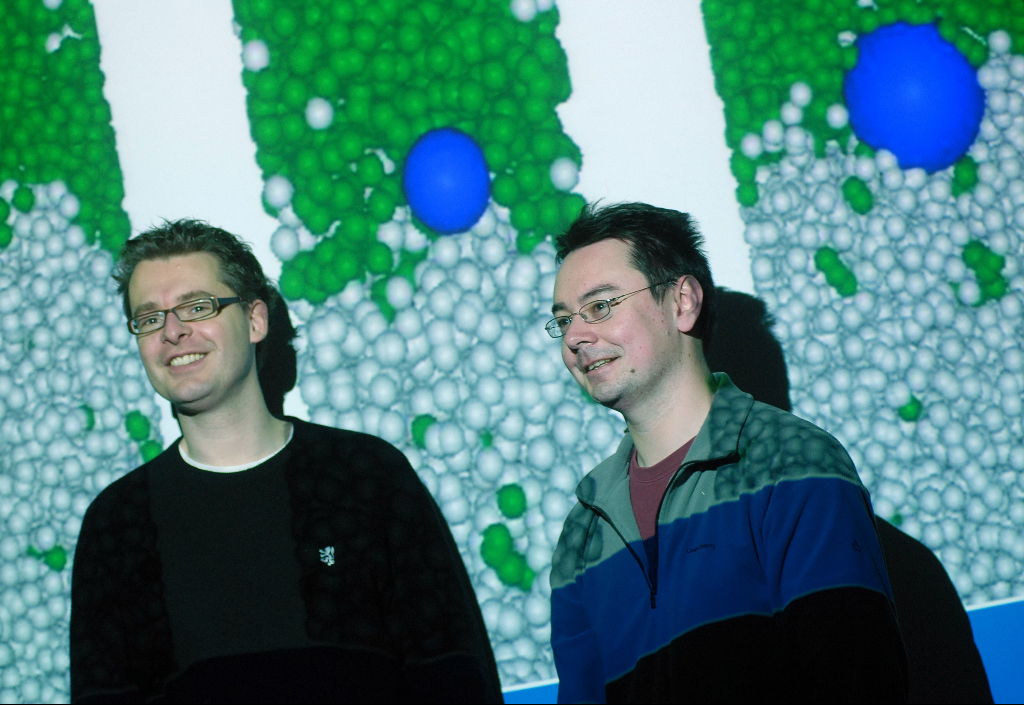
Chemistry researchers at the University of Warwick have found that tiny nanoparticles could be twice as likely to stick to the interface of two non mixing liquids than previously believed. This opens up a range of new possibilities for the uses of nanoparticles in living cells, polymer composites, and high-tech foams, gels, and paints. The researchers are also working on ways of further artificially enhancing this new found sticking power.
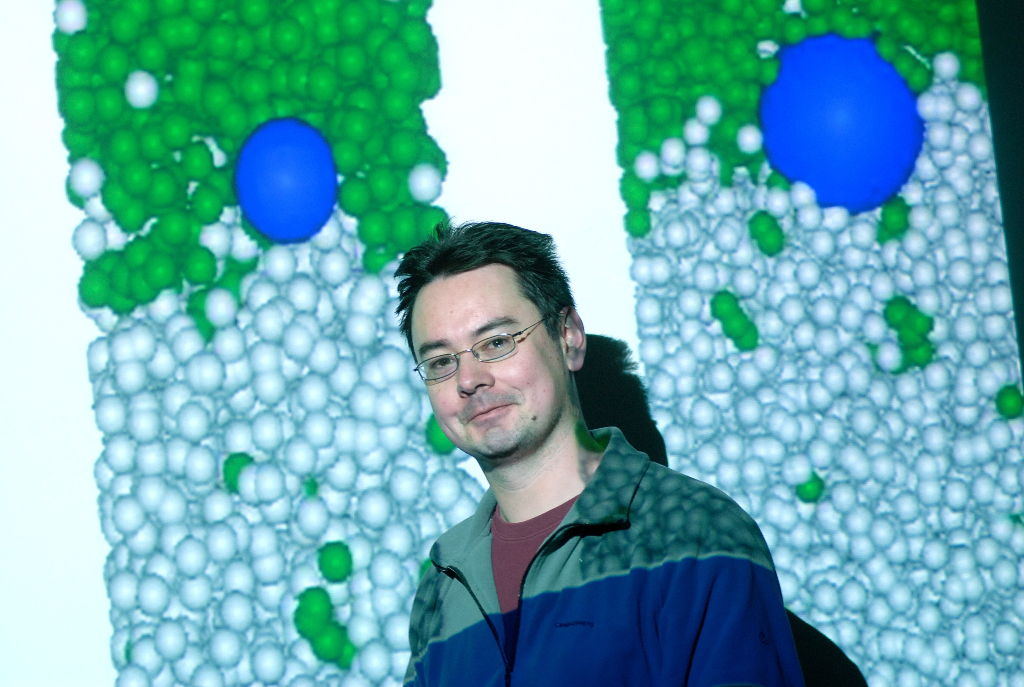
In a paper entitled "Interaction of nanoparticles with ideal liquid-liquid interfaces" just published in Physical Review Letters the University of Warwick researchers reviewed molecular simulations of the interaction between a non-charged nanoparticle and an "ideal" liquid-liquid interface. They were surprised to find that very small nanoparticles (of around 1 to 2 nanometres) varied considerably in their simulated ability to stick to such interfaces from what was expected in the standard model.
The researchers found that it took up to 50 percent more energy to dislodge the particles from the liquid-liquid interface for the smallest particle sizes. However as the radius of the particles increased this deviation from the standard model gradually faded out.
The researchers, Dr ir Stefan A. F. Bon and Dr David L. Cheung, believe that previous models failed to take into account the action of "capillary waves" in their depiction of the nanoparticles behaviour at the liquid to liquid interfaces.
Dr ir Stefan A. F. Bon said
" This new understanding on the nano-scale gives us much more flexibility in the design of everything from high-tech composite materials, to the use of quantum dots, cell biochemistry, and the manufacture of new "armored" polymer paint particles."
The researchers are now working on ways to build on this newly found natural stickiness of nanoparticles by designing polymer nanoparticles with opposing hydrophobic and hydrophilic surfaces that will bind even more strongly at oil/water liquid interfaces.
The research was funded by the Engineering and Physical Sciences Research Council (EPSRC)
For further information please contact:
Dr Stefan Bon, Associate Professor of Polymer Chemistry ,
Department of Chemistry. University of Warwick
Tel: 024 7657 4009 Email: S.Bon@warwick.ac.uk
Or
David L. Cheung, Department of Chemistry & Centre for Scientific Computing,
University of Warwick, Tel: 024 76522261, david.cheung@warwick.ac.uk
Peter Dunn, Press and Media Relations Manager, Communications Office, University of Warwick,
Tel: 024 76 523708 or 07767 655860 email: p.j.dunn@warwick.ac.uk
PR11 PJD 16th February 2009