
Research gives crystal clear temperature readings from toughest environments
 Researchers at the University of Warwick and Oxford University have developed a form of crystal that can deliver highly accurate temperature readings, down to individual milli-kelvins, over a very broad range of temperatures: -120 to +680 degrees centigrade.
The researchers used a “birefringent” crystal which splits light passing through it into two separate rays. Research has already shown that the size of the effect will increase or decrease in proportion to the temperature of the crystal. Therefore, in theory, you could calibrate such crystals to be highly accurate temperature gauges.
However, the use of birefringence in this way has significant problems in practice. This temperature measuring ability of highly birefringent crystals is badly compromised by changes in the thickness and orientation of the crystal. This adds expense to the manufacture and calibration of such crystals and makes them almost unusable in situations where, for example, vibration could alter the orientation of the crystal.
However the Warwick and Oxford researchers have developed a reproducible a and low-cost method of modifying the properties of crystalline lithium tantalate so that its birefringence is virtually independent of the crystal’s thickness and position making it resistant to vibration and cheaper to manufacture. In fact, they have made the birefringence almost zero in magnitude in all directions (the material is close to being optically isotropic just like ordinary glass). However, the slightest temperature change induces a rapid increase in birefringence in these materials, making this a reliable, robust and very sensitive method for measuring temperature. The inventors have named their device a Zero-Birefringence Optical Temperature Sensor ( (Z-BotS) and are currently seeking follow-on funding to develop the device from the bench-top proof-of-concept to a miniaturized commercially-viable package.
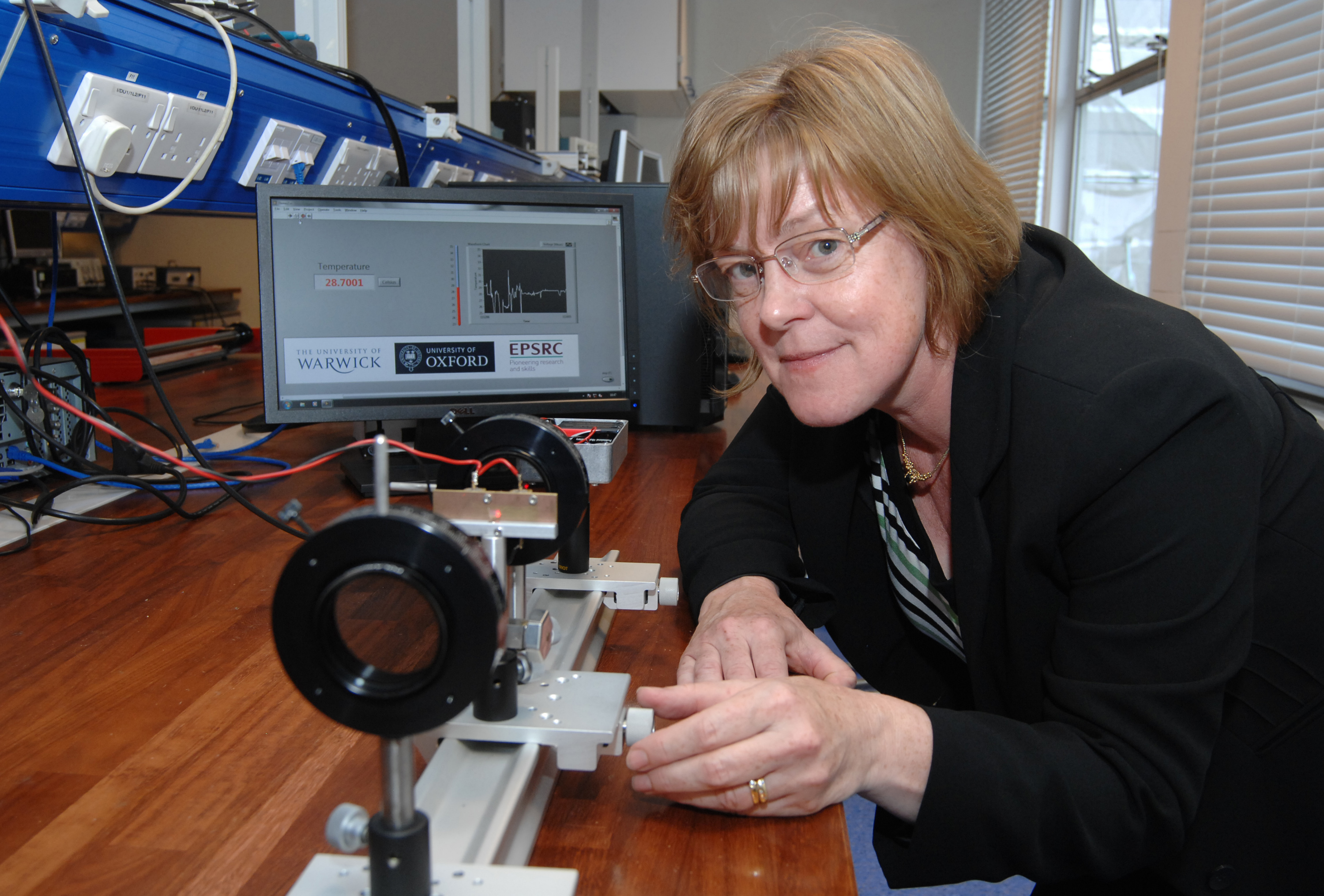 Professor Pam Thomas of the University of Warwick said:
“This advance, which has come out of research funded by EPSRC, allows us to create a new generation of robust reliable birefringent crystal based temperature sensing equipment which will be particularly valuable in electromagnetic, radio frequency and high voltage environments, where other types of sensor are subject to large errors due to interference. Examples are temperature measurement within the vicinity of MRI scanners in hospitals, industrial microwave dryers and the human body.”
Professor Mike Glazer of the University of Oxford said,
“This opens new possibilities for remote temperature sensing of challenging environments. As the birefringence changes detection in these crystals can actually be operated remotely as only the crystal itself needs to be in the environment. All the other components: light source, measurement and processing electronics can be situated remotely.”
Note for editors: This invention is now the subject of a patent application, and the researchers are working with Isis Innovation and Warwick Ventures to explore licensing opportunities for the this new technology see http://www.isis-innovation.com/licensing/6600.html
For further information please contact:
Professor Pam Thomas
Department of Physics
University of Warwick
Tel: +44 (0)24 76523354
P.A.Thomas@warwick.ac.uk
Professor Mike Glazer
University of Oxford
m.glazer1@physics.ox.ac.uk
or
Peter Dunn, Communications Office, University House,
University of Warwick, Coventry, CV4 8UW, United Kingdom
email: p.j.dunn@warwick.ac.uk
Tel: +44 (0)24 76 523708 Mobile/Cell: +44 (0)7767 655860
PR124 5th September 2011