
How we use the web
When you browse the web, you work fast and make quick decisions. Often you scan pages rather than read them, and it's easy to become frustrated.
How websites make you feel
Surfing the web isn't a passive process. It's active. Using websites can make you feel emotion.
Websites can be terrible. Sometimes they are hard to navigate, confusing, badly organised or poorly written. Maybe they do not provide the information you want.
If a website makes you feel stupid, frustrated, let down or angry, you lose confidence, leave the site and not return.
A website has to gain your trust and confidence because using the web is an emotional task. Brand and reputation can depend on making you feel confident and establishing trust. If you have a positive experience, you're more likely to buy a product, book a ticket, register for a newsletter or post a comment.
How people use websites
It's useful to think about how you and others use websites. Few people enjoy looking at computer screens. They're grainy, they flicker, and they make your eyes hurt. You develop behaviours to cope.
Speed
You work fast and make quick decisions, sometimes impatiently.
Scan
Rather than read every word, you scan. You glance at the stuff that catches your eye. You scan because you know you do not need to read everything and because you're good at it. You've been scanning newspapers and books for years and know how to do it.
Satisfice
Satisficing is choosing the first reasonable option available, not necessarily the best. It's a mix of satisfy and suffice. You click the first link that indicates it might have the information you're looking for.
As you get nearer to your target, you spend more time on a page, reading rather than scanning, and making more informed choices. This habit only happens when you feel you're getting close to the information. Until that point, it's all about speed, scanning and satisficing.
Eye tracking
Watch the following video of someone using the Squidoo website. The video shows how the person's eyes move, so you can see what they look at on the web page and where they focus.
The blue line shows eye movement. The blue circle shows the current position. The circle gets bigger when the person focuses on a part of the page for a few seconds. Notice how quickly the visitor moves around the page and how little they read before navigating to another page.
Here are heat maps of three different websites drawn from eye tracking studies, which show where people look. Red areas show parts of the page where people focused the most. Blue areas indicate where people skimmed. They did not look at the grey areas.
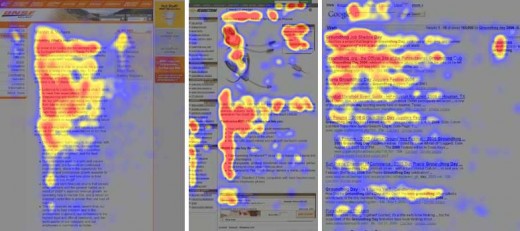
Image source: DreamGrow
Notice the rough F-shape. Visitors start at the top left corner, reading from left to right as they orient themselves. The further down the page they read, the more they scan.
Note how:
- some visitors focus on the navigation links in the first and second websites' respective menus
- they ignore banners
- they scan or ignore large sections of text
- they are drawn to sub-headings that break up continuous text
Contents
Advice and support
webteam at warwick dot ac dot uk
webaccessibility at warwick dot ac dot uk