
Philip Carter
I am an Early Career Fellow at the Institute of Advanced Study working in the Astronomy and Astrophysics group at the University of Warwick.
Research
My research interests lie in the field of accreting compact objects, particularly in interacting binary stars. My research focuses on the ultra-compact AM Canum Venaticorum (AM CVn) binaries and related systems. A large fraction of the 'stars' in our Galaxy are actually binaries, each component held in orbit by their mutual gravitational attraction. Close binary systems produce a host of interesting phenomena, many of which are associated with accretion.
|
|
| Artist's impression of an accreting binary (STScI). |
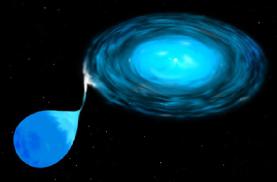
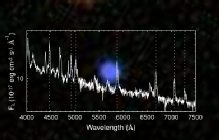
There are currently ~35 objects classified as AM CVn binaries, their orbital periods range from 5 to 65 minutes and they appear as faint, blue, variable objects (a recent review is given by Solheim, 2010).
My work has involved analysis of data related to a survey designed to spectroscopically identify new AM CVn objects hidden in the photometric database of the Sloan Digital Sky Survey (Roelofs et al., 2009; Carter et al., 2013).
See this page for more details.
Publications and Conferences
Recent publications
- Two new AM Canum Venaticorum binaries from the Sloan Digital Sky Survey III, 2013, MNRAS, 439, 2848.
Carter, P. J.; Gänsicke, B. T.; Steeghs, D.; Marsh, T. R.; Breedt, E.; Kupfer, T.; Gentile Fusillo, N. P.; Groot, P. J.; Nelemans, G. - The AM Canum Venaticorum binary SDSS J173047.59+554518.5, 2013, MNRAS, 437, 2894.
Carter, P. J.; Steeghs, D.; Marsh, T. R.; Kupfer, T.; Copperwheat, C. M.; Groot, P. J.; Nelemans, G. - The helium-rich cataclysmic variable SBSS 1108+574, 2013, MNRAS, 431, 372.
Carter, P. J.; Steeghs, D.; de Miguel, E.; Goff, W.; Koff, R. A.; Krajci, T.; Marsh, T. R.; Gänsicke, B. T.; Breedt, E.; Groot, P. J.; Nelemans, G.; Roelofs, G. H. A.; Rau, A.; Koester, D.; Kupfer, T. - A search for the hidden population of AM CVn binaries in the Sloan Digital Sky Survey, 2013, MNRAS, 429, 2143.
Carter, P. J.; Marsh, T. R.; Steeghs, D.; Groot, P. J.; Nelemans, G.; Levitan, D.; Rau, A.; Copperwheat, C. M.; Kupfer, T.; Roelofs, G. H. A.
Conference Talks
- The hidden population of AM CVn binaries in the SDSS. The Golden Age of Cataclysmic Varaibles and Related Objects II, Palermo, Sicily, September 2013.
- A new pathway to AM CVn binaries. National Astronomy Meeting, St Andrews, July 2013.
- The hidden population of AM CVn binaries in the SDSS. 3rd International Workshop on AM CVn stars, Warwick, April 2012.
- The hidden population of AM CVn binaries in the SDSS. UK-Germany National Astronomy Meeting, Manchester, March 2012.
History
I completed my undergraduate studies in Physics at the University of Warwick in 2010. With support from the STFC, I then studied for a PhD in the Astronomy group at Warwick, under the supervision of Prof Tom Marsh and Dr Danny Steeghs. In 2014 I was awarded an Early Career Fellowship by Warwick's Institute of Advanced Study.
Links
Write to:
Philip Carter,Contact details:

UTC: