
Warwick Astronomy PhD Projects
High-speed CCD Photometry of White Dwarf Binary Stars
Interacting binary stars are dynamic objects which require high-speed observing techniques. For instance, they can show sharp features during eclipse that last 30 seconds, or less, and flare on shorter timescales still. While the advent in the early 1980s of CCDs brought many advantages, it was bad for high-speed work because of their slow readouts. To address this we have developed and operated instruments based upon what are known as "frame transfer" CCDs. These CCDs have an area for taking images, and one of the same size that acts as a buffer. This allows them to take images rapidly while reading them out slowly enough not to add too much noise. We have run one such instrument, ULTRACAM, for 10 years now, and are in the midst of developing one called ULTRASPEC which we will mount on a 2.4m telescope being built in Thailand.
These are instruments that can and have been used in a wide range of experiments including observations of pulsars, pulsating stars, Solar system occulatations and accreting black-hole systems. However, the primary projects of interest at Warwick concern white dwarfs in binary systems. These come in four main varieties: detached white dwarf/main-sequence pairs (see below for an example), semi-detached white dwarf/main-sequence pairs also known as cataclysmic variable stars in which accretion is taking place, and detached and semi-detached pairs of white dwarfs. Key points of interest are: (1) amongst these systems may lurk the progenitors of Type Ia supernovae, which makes their properties of interest for establishing whether this is possible, (2) the build-up of mass on accreting white dwarfs is a critical process in producing supernovae which can be investigated with these systems, (3) the processes of angular momentum loss and transfer can be probed, (4) from work we have carried out it is starting to appear that some of these systems have planets in orbit around the central binary, which we can see through modulations of the times of eclipses. This is allowing us to detect very long period planets, and is of great interest given that the binaries themselves typically were once much more widely separated raising issues of orbital stability that are so far unexplained.
Project at Doi Inthanon, Thailand: in November 2013 we started a new project with the mouning of a camera called "ULTRASPEC" on a 2.4m telescope on Thailand's highest mountain, Doi Inthanon. Considerable observing effort is required to support this, which makes for good PhD student training. This includes observation, reduction, analysis and write up.
Example of fast imaging
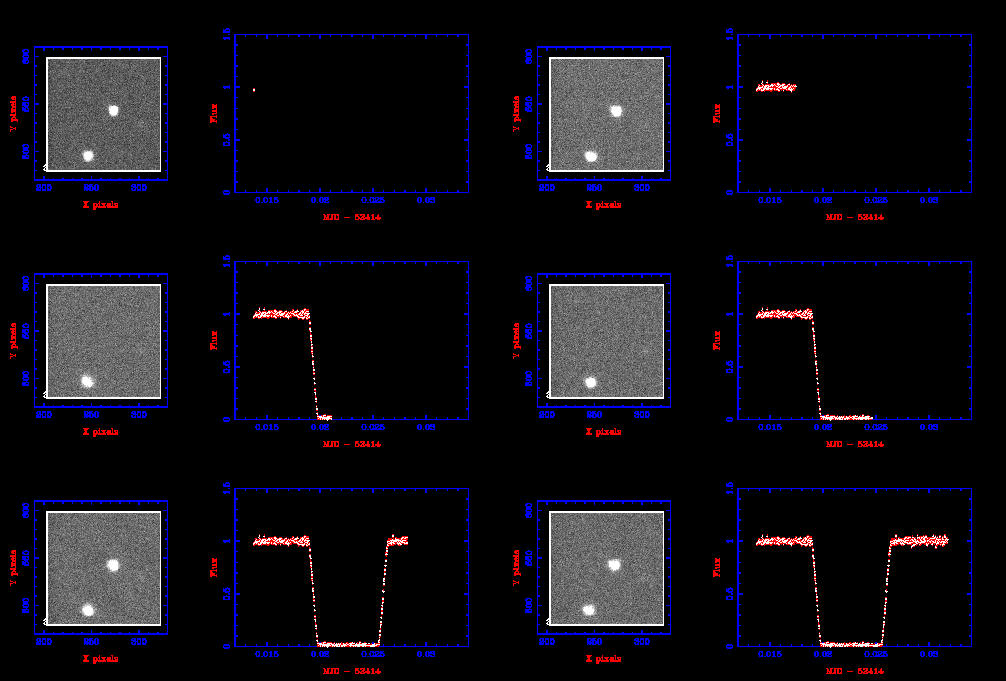
The movie shows ULTRACAM's view of a remarkable eclipsing binary star called NN Serpentis. This star consists of a compact white dwarf (old stellar remnant comparable in size to the Earth) and a much larger cool companion. The companion reveals its presence when it passes between us and the white dwarf. The eclipse takes 12 minutes in real time; only 1 in 5 images are plotted here in order to keep the file size reasonable. The aim of this project was to measure angular momentum losses which are crucial for binary evolution. The results were very puzzling however, and it now seems that the system may in fact be perturbed by the presence of two planets. The analysis of the system's parameters were written up by Warwick PhD student Steven Parsons and provide a good example of the nature of the work involved.
Supervisor: Tom Marsh
Please fill in our PhD enquiries form if you are interested in studying for a PhD in Astronomy at Warwick.
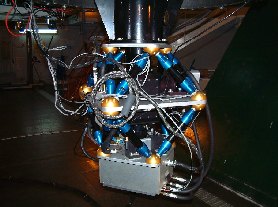
ULTRACAM at the 4.2m WHT on the island of La Palma in the Canary Islands.
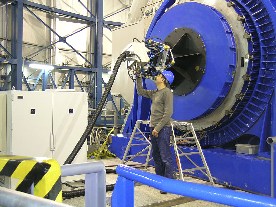
ULTRACAM at the 8m VLT in Chile.

Doi Inthanon, Thailand.